Showing posts with label Herbs. Show all posts

Sunday, March 18, 2012

March Madness

The madness has set in. Not college basketball madness. I'm talking spring garden madness. Average temps have been consistently warm for the past few weeks, and I think the plants in the yard believe it is April. Enjoy the following picture tour of March Madness at .09 Acres:

Still harvesting Chantenay Red Core carrots from the garden.
This 18.5 oz carrot dwarfed the 14.1 oz carrot I harvested 2 months ago. I don't have the largest hands, but this octopus-like carrot is ridiculous. This carrot is grown from seed I purchased from Southern Exposure Seed Exchange (SESE).
Japanese maple waking up from winter slumber. This tree was a seedling from parent's old house in Virginia Beach. I also gave a second seedling (now about 8 feet tall) to my friends Elsa and Matt in Norfolk.
Gardeners know that mint is extremely invasive. Here is a half-barrel of mint scrambling for more real estate. 
Rosemary. Yum.
Rosemary blooms. Yum?
Cold hardy mache appears as if it will be going to seed very shortly. It doesn't like hot weather.
Arugula in full bloom. I save seed from this plant every year. It's very easy. Just wait for the seed pods to dry on the plant, then cut the flower stalk and shake the dry pods in a brown bag. Voila! Seeds!!
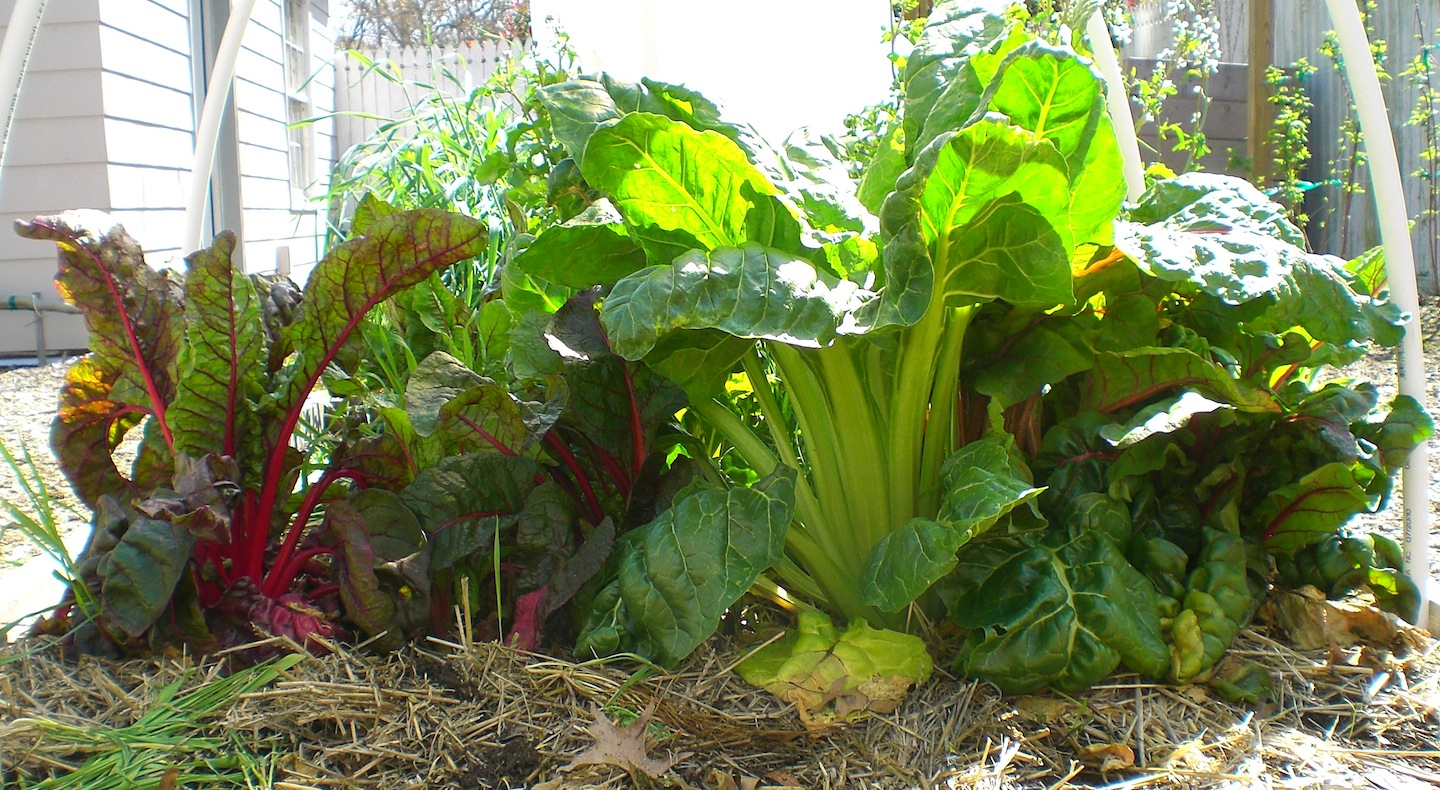
A 4-foot row of various Swiss Chard. This stuff is versatile in the kitchen and grows in all weather conditions.
Ruby Red Chard from SESE.
Kale. I grew my kale exposed all winter. No plastic, floating row cover, or hoop house. Resilient for sure. Try kale soup with chorizo. You won't be disappointed.
Red bunching onion grown from SESE seed sown last fall.
This Calabrese broccoli is destined for pasta with olive oil and garlic.
Winter Density has been the top lettuce producer in my garden for the past two years. The only problem I have is dealing with slugs and aphids that crawl inside the wrinkly leaves. Nothing a little water won't solve.
A row of trellised Fall Gold, Kiwi Gold, and Heritage Red raspberries. These are a must-grow in the Mid-Atlantic and Tidewater area.
Thornless Ouachita blackberries busting loose.
Potted lemon tree preparing to bloom. Looking forward to a better citrus harvest in 2012-13. This past year was disappointing. I only harvested a handful of lemons and limes.
Russian Red Pomegranate (8 feet tall) from Edible Landscaping in Afton, VA.
Russian Red Pomegranate leaves reaching for the sun.
Celeste fig tree (appx. 6 years old) from the now-closed Paradise Nursery. I've pruned this every year in order to encourage a low, wide shrub-like growth. More branches = more figs.
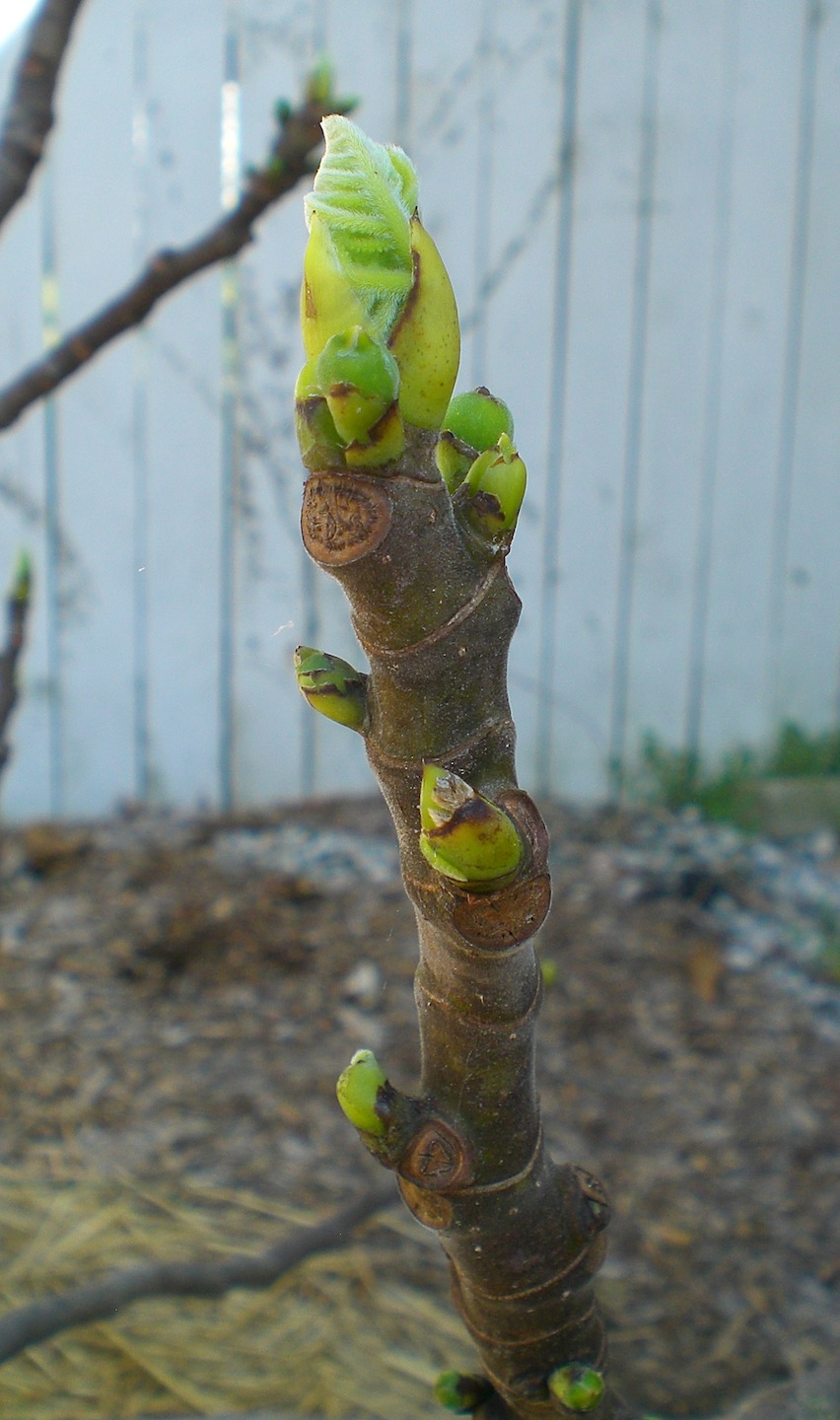
The tip of a Celeste fig tree branch. Notice the combination of new leaves and tiny figs. Some varieties of figs produce 2 harvests per year. The early figs are called brebas.
Another view of the Celeste fig tree. Note the multiple growths on each branch. If I didn't prune, I would have a tall, lanky tree rather than a dense shrub.
My fig espalier at the corner of my garden shed. 3 days ago I pruned off all of last year's vertical growth near the two main horizontal arms. I left a single vertical node from last year's growth in order to allow the new branches to grow from those same locations this year. I will repeat this process year after year. Grow, harvest, prune. Grow, harvest, prune.
Detailed photo of a vertical node extending from a horizontal branch of the Celeste fig espalier. New growth will appear on the rough area of the top portion of the vertical node. New growth will also likely appear elsewhere, but I will prune or rub off the new growth before it negatively impacts the desire appearance of the overall espalier. 
I hope you enjoyed your tour of March Madness at .09 Acres. My apologies for not posting here more consistently during the past few weeks. Work has been eating me alive, and it's great to be back outside again. Wishing you good growing and great harvests in your gardens!

Thursday, November 3, 2011

Enjoying the Fall Garden

Like many people, I started out as a spring and summer vegetable and fruit gardener. Warm weather meant planting and harvesting. Cold weather meant waiting for next year's harvest.

It took me a few years and lots of trial and error to realize that cool season gardening can sometimes be the most rewarding gardening of all. The most notable differences between fall and summer gardening in Zone 7b are comfortable temps, very few bugs and pests, care-free veggies, and generally easy tasks. 

In its simplest form, fall gardening consists of sowing seed (in late summer), watering, mulching, more watering, and harvesting. That's just about all there is to it. Some hardier crops even survive repeated frosts and in a location like Newport News, VA, a productive four season garden is a realistic goal. 

I took the following photos of my fall garden at .09 Acres on Halloween, 2011.  

Long rows of Buttercrunch and Winter Density lettuce.
Young Rouge d'Hiver lettuce sown in succession with other lettuce varieties to extend the harvest. Succession planting spreads out the harvest over a few weeks or months.
Long Standing Bloomsdale spinach. This is my first attempt at growing spinach. I found that warmer soil temps in late September definitely hindered germination, but the spinach seems much happier in early November.
I had spotty germination of my carrots. Notice that the center two rows filled out nicely while the outer rows (far left and far right) are fairly sparse. I'll have to wait and see how they do this year. Last year was an amazing year for carrots.
It's tough to beat good beets. Here are four short rows of Detroit Dark Red and Chioggia beets. These are still quite young and probably need another month to grow. I thinned them in mid-October to allow the beet roots to grow larger, and I added the thinned greens to a salad. Definitely a great addition.
I am growing kale from seeds I saved (this spring) from last years kale plants. I battled tiny caterpillars for a few weeks when the plants were young, and you can see some of the leaf damage they caused in this picture. 
I am growing broccoli in two large pots and in a raised bed. I'm curious to see whether it grows better in-ground or in the pots. I can't remember if I planted Calabrese or Waltham broccoli. I have to check my seek packet. I may have started these seeds too late for the plants to mature in time to produce harvestable broccoli, but only time will tell. The tiny caterpillars that hit my kale also like the broccoli. Damage is visible on the right-most leaf.
Apple mint growing in half a wine barrel near the gate to my yard. It has made an amazing comeback from the crippling heat of mid-summer. This plant thrives in mid-late spring, suffers through summer, then regrows with a vengeance in fall. This entire barrel grew from a small rooted cutting I dug up from a yard where I previously lived. Mint will take over the world if it's not contained, but it's also a must-have in any yard.
Russian Red pomegranate ready for harvest. There are appx. twenty of these hanging from my 4-year old pomegranate tree. I can't say enough good things about this tree.
Negronne figs that definitely will not have enough time to ripen before the first frost. This tree keeps growing larger and producing more figs. Next year should be an amazing harvest. 
Two unripe Eureka lemons hanging from a small branch on my potted tree.
New foliage on my Eureka lemon. It usually starts out with a reddish tinge, then turns bright green as the leaves grow and mature.
More blossoms keep appearing on my potted Bearss lime tree. Citrus flowers are arguably some of the best smelling flowers in nature. My lime tree is currently holding about 10 limes. After last year's harvest, I thought it could've grown 50 limes this year. But a strong gust of wind knocked it off a table in early spring and snapped off the main trunk. I'm pretty sure I cried when I finally found out what happened.
Baby Bearss limes growing from recently pollinated flowers. I won't be dining on these limes for a LONG time!
What are your favorite fruits and veggies to grow in the fall? Are you thinking about adding additional cold-weather protection like floating row covers or plastic-covered hoop houses to extend your harvest into the winter? Fall is finally here so welcome it into your garden.


Tuesday, September 7, 2010

September in the Garden

The weather is changing.  Don't get me wrong -- it's still ridiculously warm, but the humidity is starting to break and the weather is now in the 60s at night.  I snapped a few pics this evening because I recently started transitioning the raised beds to fall production by planting seeds.  Carrots, swiss chard, kale, lettuce, onions.  Many seeds have already germinated!  But still no luck with the lettuce.  I think the recent temps in the upper 80s and low 90s combined with very little rain may be the problem(s).

Swiss chard seedlings.  This is my first year growing chard.  Got my fingers crossed.
Kale.  Perfect greens for soup and holds up well even in frost.
Carrots.  I planted six different varieties.  This is only my second attempt at carrots.  I failed two winters ago for a variety of reasons.  Not this year!

While these pictures suggest fall, the figs and basil are still producing as if it is mid- to late-summer.  This will be my second huge harvest of basil (I've got pesto coming out of my ears) and I'm pretty sure these figs will ripen before it's too late.  The Heritage raspberries have also done pretty well despite my neglect, and of course those tasty gems get eaten well before any thought of a picture.

I planted basil down the sides of my tomato beds for a companion crop.  Still going strong.
Peter's Honey figs peaking out from the dark green foliage.