Showing posts with label Cuttings. Show all posts

Friday, July 8, 2011

Propagating Figs

Back on March 28, I started to root approximately 100 fig cuttings in plastic 16 ounce cups filled with moist perlite. I used dormant cuttings ranging in size from 8"-12". I was moderately successful rooting Celeste figs in previous years, so this year I was excited to get access to a wide variety of figs including Blue Celeste, Panache, Alma, Hardy Chicago, Strawberry Verte, Violette de Bordeaux, Osbourne Prolific, and Italian Golden Honey. It's been just over 3 months since I started the cuttings, and to date I have successfully rooted many cuttings. I am now in the process of transitioning the rooted cuttings from perlite to compost in plastic nursery pots to grow in the shade until they are established. The following pictures show the process:

Assorted fig cuttings in perlite.  This picture was taken on March 28.  I kept them inside my unheated garden shed until the weather warmed, then I moved them outside onto a table beneath a shady tree where they stayed for a few months.  The rooting process really speeds up in warm/hot humid weather.  This makes the process easy and successful in southeastern Virginia.
Here is a rooted cutting of Hardy Chicago on July 7.  Notice it has lush foliage.  Here's where it gets tricky.  Foliage growth is not necessarily a sign that the fig has rooted.  Sometimes a cutting will grow leaves but not roots.  This is why potting in clear plastic cups is an advantage.  It's much easier to see if and when roots have grown.
Check out the root growth in the bottom of the plastic cup.  I decided to transition this cutting from perlite to  compost in a plastic pot because of the strong root growth AND new foliage.
Here's a photo of the rooted cutting after I removed it from the cup.  The roots are holding the perlite together.  
I put a few inches of compost in the bottom of a pot and place the rooted cutting into the pot.  The perlite usually crumbles apart but it's not a big deal.  I like to include all the perlite from the cup because I believe it helps to transition the cutting to the new potting media. I use the inside of an old wheel barrow as my potting area. 
I make sure the cutting is vertical and then I add compost to the pot until it is even with the rim. I never compress the compost around the new cutting because I believe it can damage the young roots. Compost is light and fluffy and the rooted cuttings seem to respond well to it.
Here is a final picture of the new Hardy Chicago fig.  It's been watered and labeled.  A good labeling system is very important because it's easy to get them all mixed up when you have dozens of cuttings and no labels.  I also do not add any fertilizer.  The compost provides sufficient nutrients for the remainder of the year. This cutting will now join the others in the shady canopy of a massive crepe myrtle.  Once the fig shows strong new growth, I'll move it into a sunnier location.  As long as I keep my cuttings watered, they'll grow 4-5 feet by the time October rolls around and temperatures cool down.
Propagating new fig trees from cuttings is a fairly easy process. The hardest part is waiting!  I encourage you to give it a try. Before you know it, you'll have a yard filled with fig trees.

Monday, August 2, 2010

Figs!

I'm a fig junkie.  Right now many of you are probably rolling your eyes thinking about grandpa's nasty dried figs.  But if you haven't eaten a fig plucked FRESH from a tree, you don't know what you're missing. I eat them whole, sliced, chilled, and even grilled.  And yes, also dried when not in season, but it's like comparing apples and oranges.  There are many tasty varieties that do well in southeast Virginia.  Right now I'm growing Violet de Bordeaux, Black Jack, Celeste, and Peter's Honey.  I've been growing them for a few years and they are still relatively small.  Violet is definitely my favorite, Black Jack is so-so, Celeste is old reliable, and Peter's Honey is a green fig that hasn't done very well this year.

Unripe Violet de Bordeaux figs.  They are very dark and droop when ripe.
Ripe Violet de Bordeaux figs.  Notice the distinct change in color and size when ripe.
It's actually quite easy to propagate figs by rooting dormant cuttings.  I took cuttings of my uncle's Celeste fig tree late last winter and rooted them in perlite this spring.  Then I moved them to 1 gallon pots and now they are growing like weeds.

2-3 feet tall rooted cuttings from a mature Celeste fig tree.
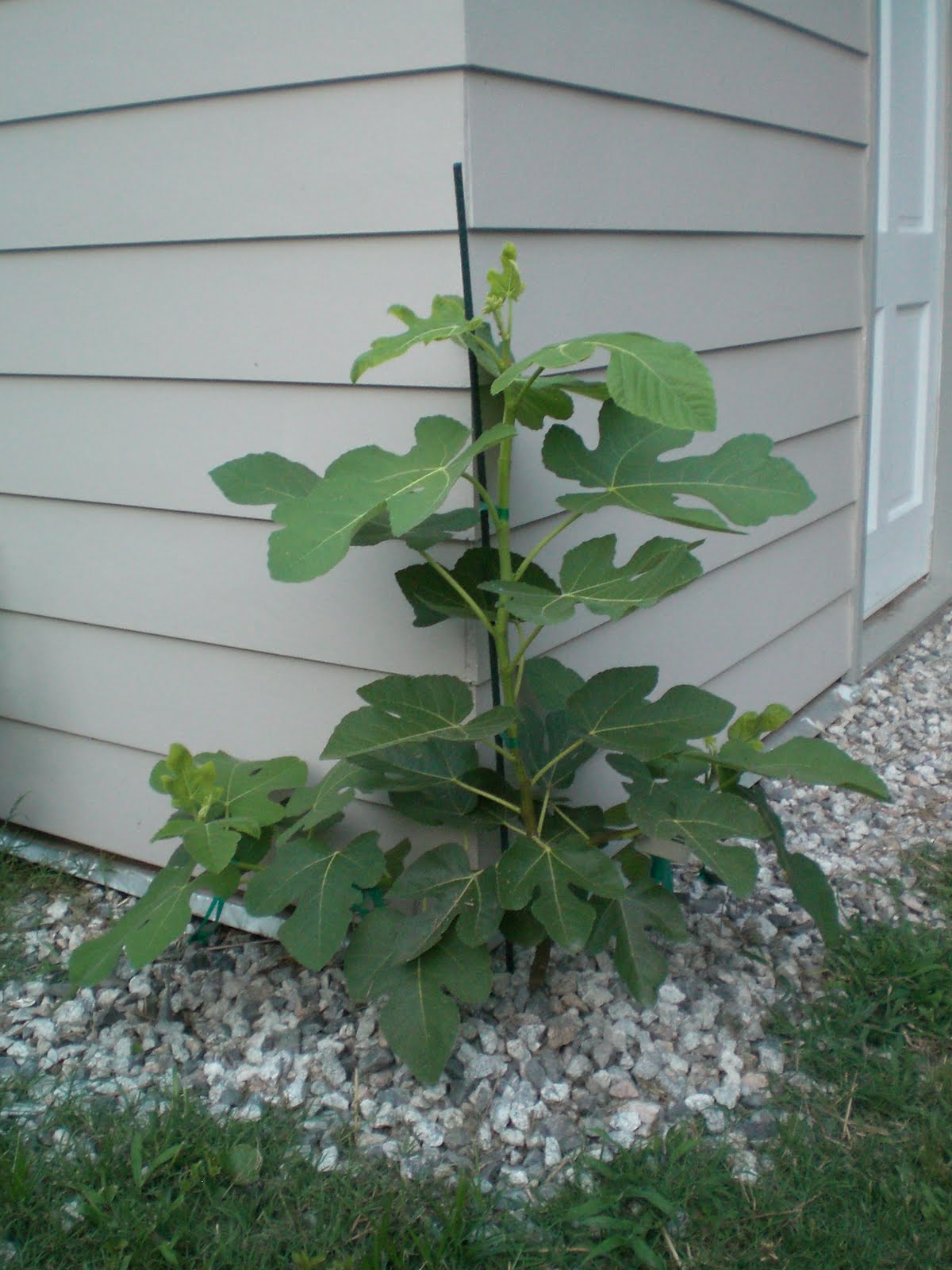
I'm also growing an espalier fig against the corner of my shed.  I'm training two long branches very close to the ground (much like a stepover) and growing two more branches a few feet up, similar to a traditional multi-tier espalier.  It will take a few years to train the fig for the right appearance, but I'm looking forward to the challenge.  Notice the growth from the left picture (early June) to the right picture (early August).  The tree currently stands about 5 feet tall and is developing nicely.