Showing posts with label Peaches. Show all posts

Monday, September 19, 2011

Heritage Harvest Festival

Last Saturday, the family and I attended the 5th Annual Heritage Harvest Festival at Thomas Jefferson's Monticello in Charlottesville, Virginia.

Image courtesy of the Heritage Harvest Festival. Jefferson's Monticello is on the top left of the image, and his terraced vegetable garden and orchard is located along the right side of the image.
Jefferson was a pioneer of and ultimate advocate for sustainable agriculture, and this made Monticello the perfect location for this great event. In short, the festival included everything from seed sales and heirloom tomato and watermelon tastings to hands-on workshops, presentations, and tours of Jefferson's amazing home, garden, and orchard. I highly recommend this event for anybody interested in all aspects of agriculture and simpler ways of living.

I could write pages and pages about the importance of everything presented at the event, but I figure most people who read this blog likely agree that a handful of seeds, the sweat of your brow, and dirt on your hands can lead to some pretty amazing things. Instead, here is a photo-journey of Thomas Jefferson's garden.

Southwest view of Jefferson's expansive vegetable garden. He located it on a south slope to maximize the sunlight, growing seasons, and air movement down the slope.
Peach and other fruit trees in Jefferson's orchard (center of image). Corn is visible in the left foreground, blooming rosemary on the right, and I'm not sure what's blooming in the center.
A staggered row of sea kale.
A lush bed of sweet potatoes.
Tree onions, also called top-set or walking onions, are very hardy perennial and multiplying top-setting onions. This means that they form new onion bulblets where most onions form flowers. They don't produce very large bulbs, but they are fun to grow and nearly impossible to kill. If you've never tried growing onions, start with these to boost your confidence.
Two rows of onions in between peppers and squash.
French artichokes and a nifty wooden plant label.  Each row of veggies, herbs, and flowers was clearly identified by these labels, which made it much easier to identify specific varieties of plants.
I had never seen sesame before, other than on my bagels, but Jefferson's garden was loaded with it.  Each one of these pods is filled with sesame seeds. I broke open one of the drier, yellow pods with my fingers and seeds spilled onto the ground. I can't think of any other museum or heritage site where you can touch AND break part of the display or exhibit without being arrested!
This West Indian Gherkin (cucumis anguria) caught my eye. This beast doesn't look safe or edible...probably why it remained untouched.
Faded sign on a weathered fence that surrounds Jefferson's old nursery. 
Mulched pathway that cuts through the nursery. In the background you can see the edge of the vineyard.
In the orchard. Jefferson loved peaches and fought the noble fight that we still know today as "growing peaches organically". He had about as much success as we do today... 
Aerial view of Monticello not taken by me. I don't have a helicopter or a proper photo credit.
If you are interested in specific information about Jefferson's agricultural successes and failures at Monticello, you should read Thomas Jefferson's Garden Book. It's a compilation of his horticultural diaries, letters, and sketches. Probably more info than you ever wanted to know about the principal author of the Declaration of Independence and third President of the United States. For example, you'll read in his own words about his love of sweat peas, his favorite veggie. Random, but true.

Did anybody else attend the Heritage Harvest Festival this past weekend? Have you ever been to Monticello? I look forward to hearing from you.

Thursday, July 7, 2011

Peaches, Ants, and Tanglefoot

I've been keeping a close eye on my Redhaven peach tree for the past few days because it's almost peach time. The ants know this too. They've been climbing the trunk and working their way into limbs and fruit. I noticed a gouge in one of the peaches and saw an ant crawl out of the hole. Then a few more crawled out. Apparently ants are camera-shy because I only caught one with the camera, but I promise there were many more.

Ant and damage to a Redhaven peach.
Being a territorial guy who is not known for sharing very well, I decided it was time to take action rather than lose my precious peaches to the ants. At the recommendation of a few wise people, I broke out the Tanglefoot rather than really nasty chemicals.

A tub of Tanglefoot (center), stretchy paper wrap (right), and insecticidal soap (left) to deal with my ant invasion.
Tanglefoot is a really sticky goo that you "paint" around the trunk of a tree. Ants hate the stuff and get stuck if they step in it, hence the name Tanglefoot. It's not recommended to paint the Tanglefoot directly on the trunk so I wrapped it very tightly with a stretchy paper with cotton beneath it to make sure that ants couldn't walk through a small opening. Then I took a small scoop and lathered it on the paper. Within seconds, the steady stream of ants that had previously used my tree trunk as a superhighway to peaches were in a traffic jam of chaos.

Tanglefoot wrap around the lower portion of the trunk of my Redhaven peach.   Notice the ants trapped above the Tanglefoot.  They aren't happy.  Actually, the least happy ant is the one who is trapped in the upper right portion of the goo.  
It proved very effective. Those going up the tree stopped and turned around. The others located above the Tanglefoot hiked all around the trunk looking for a way down. You're probably thinking, "What about the ants in the picture? They are above the Tanglefoot and still have access to the peaches." That is correct, but I used a few sprays of insecticidal soap to get rid of them.

We had LOTS of rain the day after I applied the Tanglefoot, but the goo stayed in place. I may need to reapply if we get more rain, but I found it very useful as non-toxic alternative to spraying loads of poison and chemicals over the entire tree to deal with the insects. Now i just need to keep an eye open for aerial invaders!

p.s. Happy Birthday to my recently-retired Dad.

Thursday, June 9, 2011

Early June

I'm back.  It's been almost 2 months since my last post.  Too long. Figured I'd do a big pictures post from the yard.  It's been an interesting and productive Spring, with a few setbacks as well. Generally speaking the garden is doing great.  Let's start with the good then I'll move on to the bad and ugly.  I successfully saved seed from my Vates kale and two varieties of Swiss chard.  They get tall when they bloom.  I'm talking 6-feet tall!  I added about 4" of fresh compost to each bed and built a small extension designated for herbs. Cucumber production has been nothing short of amazing.  I've got 5 Burpless plants in the ground and I'm pulling about 8 cukes/day.  I planted borage as a companion plant to my tomatoes, and it  is growing very well.  Beautiful flowers and they are edible too.  Peaches are hanging from the tree, the pomegranate is still in bloom. Raspberries were a tasty treat for about 3 weeks and are slowing now, but the blackberries are starting to kick in.  Figs have also put on new growth and, more importantly, many figs.  Not as many as I hoped for, but I pruned them back in early spring to encourage more branching for larger future harvests.  The fig espalier is developing fairly well.  I also just finished harvesting approximately 50 heads of Inchelium Red garlic and they are drying in my shed.  That's a short version of the good.

Now for the bad.  My precious, beloved, sacred, and coveted heirloom tomatoes are taking a beating.  They grew well for the first 6 weeks after I transplanted them into the garden, and they grew large.  I'm talking appx. 4-5 feet tall.  Then I started noticing what I believe to be blight.   It first appeared on a few leaves, then a stem, a truss of tomatoes, an entire stalks.  I quickly pruned those areas, sterilized my pruners, and then moved to the next plant.  But it kept moving.  So this past weekend and evening I ripped out 5 of my 7 in-ground tomatoes.  2 German Johnson, 1 Black from Tula, 1 Bull's Heart, and 1 Marvel Striped. I don't know why it hit so hard.  I immediately tossed them in the garbage bin.  I've been careful about watering, 2 doses of organic foliar feed (spaced 4 weeks apart) in the early morning, etc. etc., but I guess a large harvest like last year wasn't meant to be.  I'm planning on purchasing a few more plants and probably dropping in a few seeds as well, but I'm flat out bummed.

And the ugly.  Despite my best attempt at smothering the grass, it's back.  And lots of it.  Multiple layers of cardboard, 4-5 inches of mulch, periodic hand weeding of the errant shoot of grass, all for nothing.

Alright, enough gibberish!  Let's do the photos, shall we?
This is a mix of the good and the ugly.  Figs down the left, raised beds front and center, berries/peach/pomegranate on the right.  Oh yeah, and grass everywhere...son of a...
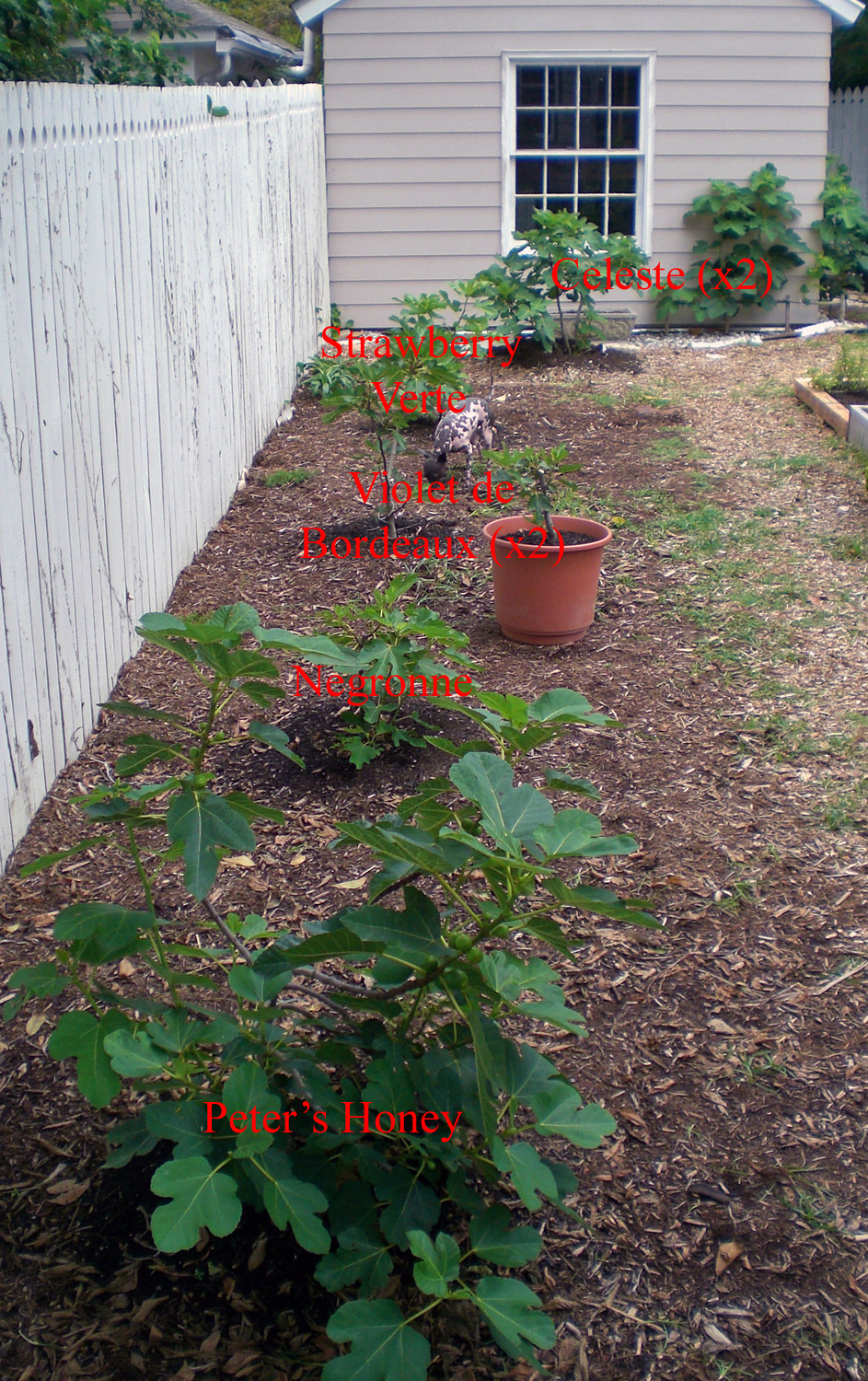
Row of figs down the left wall of the yard.  They are all fairly small, but are adapting well to their permanent location.  I grow a mix of brown, purple, and green figs.   If you look closely, you can spot Scout.  She's the hairless wonder dog.
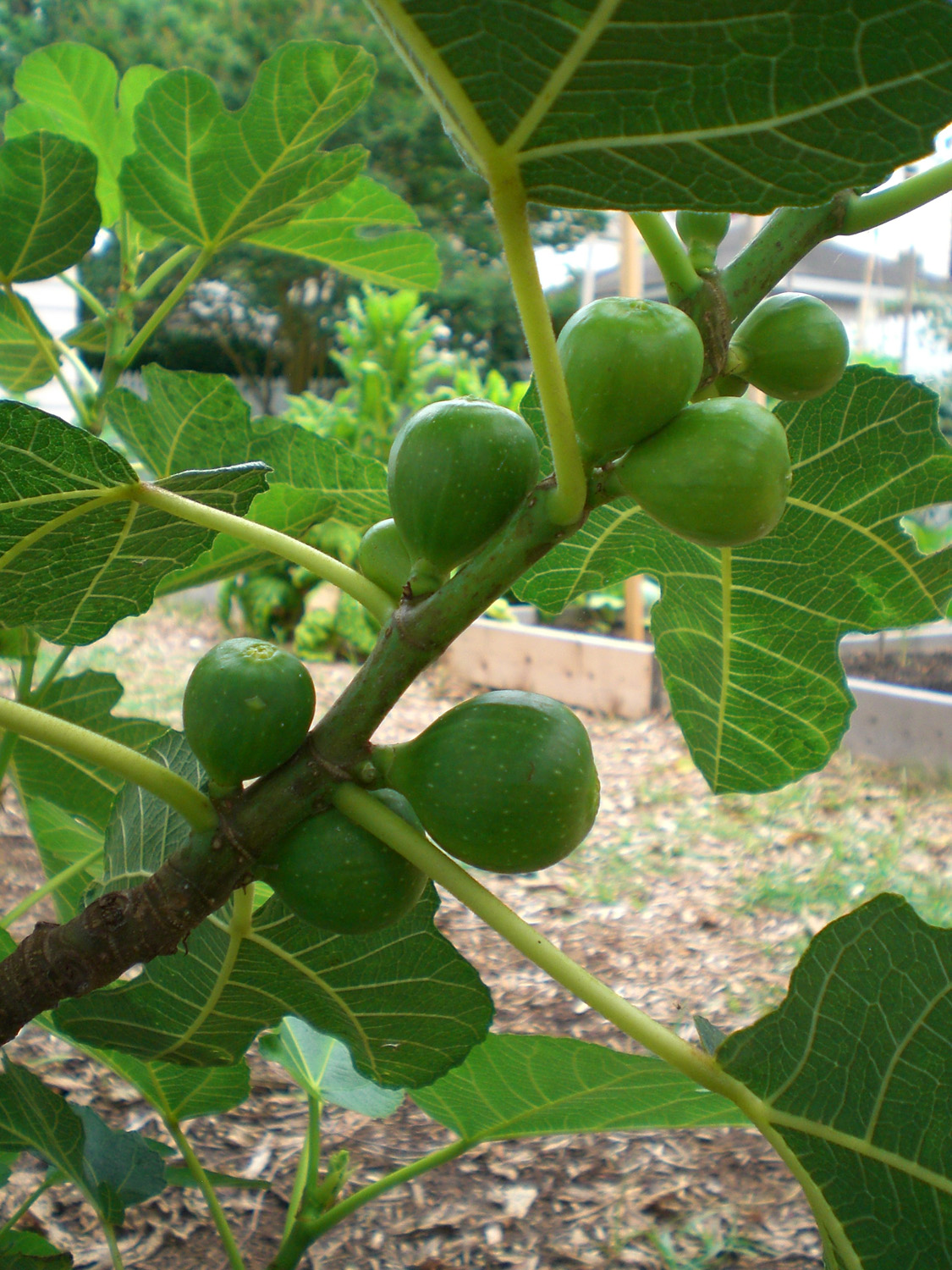
Peter's Honey fig.  In some areas this plant is putting out 2 figs per leaf, and I don't think that's very common. I'm not complaining.
Violet de Bordeaux figs.  I will pick individual ants off the tree to protect these, partly because I'm crazy but mostly because these things are heavenly.
The Red Haven peach tree is getting very large.  I pruned it heavily this winter and again about 3 weeks ago, and it keeps on growing.  I also thinned the fruits a while ago, but it's still hanging about 25 peaches.
Overhead view of the Red Haven peach tree showing the main scaffold limbs.  I'm trying to maintain an open center to allow light in and air to circulate.
I haven't sprayed this tree with a single thing this year and it still looks healthy.  I hope that holds up for the rest of the year.
The Russian Pomegranate also likes its sunny but sheltered location.  It's approximately 7' x 7' and was covered in blooms for 3 weeks.
A tiny pomegranate and a few blooms in the background.
This is a young Haku-Botan pomegranate tree, courtesy of Sybil Mays.  It will eventually produce yellow/gold pomegranates.  Sybil, this is the little plant you dug up from your side yard.  It has recovered and grown ALOT!
It's a cucumber jungle out there.  By now they've established very deep roots and don't show much wilting during the hottest (98 degrees) driest weather this year.
These beasts make a mean cucumber salad.
Ouachita blackberries beginning to ripen.  I'm not sure exactly what happened (or didn't happen), but I think poor or incomplete pollination led to irregularly shaped berries.  Look closely in the picture and you'll see what I'm talking about.
Almost ready.
All the literature says that borage flowers have a cucumber taste.  I disagree.  They taste like borage flowers.  Not really cucumbery, but just a general leafy green pleasant flavor.  I grew these as a companion plant for the tomatoes, but it clearly hasn't helped this season.  
Don't ask me how this partially ripened black cherry tomato tasted.  I wouldn't know.  My dog Diego ate it so you'll have to ask him.  
When most people draw a picture of the devil, they draw a red devil.  The devil is NOT red.  The devil is green.  Check out this mix of Bermuda grass and some other green beasts that are growing well despite Operation Smother.
Bermuda grass a-creepin'.  This is the aforementioned ugly.  I plan on pulling everything I can by hand rather than using some ineffective organic herbicide or crazy poisonous herbicide.  I do not want to mow this back yard ever again.  
I'll post again soon with pictures of the garlic harvest as well as the fig espalier.  How are things growing in your gardens?  If you are fortunate enough to have a bumper crop of heirloom tomatoes later in the summer, I'll likely be begging at your front door. That's a promise.

Thursday, April 14, 2011

Happy First Birthday .09 Acres!

It's officially been one year since I built the first raised beds and planted a few berries in the ground at .09 Acres.  The time has flown by so fast.  But before I even dug a spade into the ground or removed a single overgrown vine, I was running through all the possibilities in my mind.

Let me go back a little earlier than a year ago.  I want to start with a few photos I took in September 2009, a month before we purchased the house.  The yard was nice....quiet, private, and ordinary.  It was the type of yard you'd expect to find in my neighborhood.

September 2009 at .09 Acres.
The main problem I saw was that the yard was the exact opposite of what I wanted in a yard.  Grass that needed to be mowed, fertilized, and edged.  Overgrown bushes, shrubs, and invasive vines and ground cover that needed to be tamed and maintained.  I didn't want any of that.  I wanted to create an edible landscape filled with veggies, fruits, and herbs.  No grass, raised vegetable beds, a variety of different fruit trees.  This couldn't be the place for me.  Or could it?

Despite the numerous drawbacks, the property offered many things I was looking for in a yard.  Full sun exposure for 8-10 hours per day.  A manageable size.  Privacy fencing that offered seclusion and also created a slightly warmer micro-climate.  And a fairly open layout that I could configure any way I wanted.  Maybe this was the right place!

We eventually purchased the house but I didn't dive into the yard until we had spent a few months working on some DIY renovations inside. I finally got out into the yard in early spring and pruned or removed many overgrown shrubs, bushes, and trees.  I ripped out the creeping groundcover, and even moved the fence closer to the property line to reclaim some additional footage (it all counts in a small yard!)  By that point it was April, 2010 and I was ready build some raised beds and plant some edibles.

April 2010 at .09 Acres.
You can see a large difference between September 2009 and April 2010.  I gained quite a bit of square footage by removing old plants and moving the fence.  I also pruned the grand old Japanese Maple (back left in the above photo).  Unfortunately I had to remove it later on after I discovered that its roots caused some major damage to some nearby plumbing.

I worked when I could.  An evening here, weekends there, official holidays, work holidays. I even dragged myself outside when I was sick to pull a weed or water a new plant.  It borders on obsession at this point.

Here we are one year after I built the first raised beds.  What does the place look like now?  To be quite honest, it looks a bit bare.  But I intentionally provided sufficient space between the fruit trees to allow them ample room to grow and thrive in the coming years.  And hopefully they will.  Now the peach tree and berries are growing like crazy, the young fig trees are starting to leaf out, and I'm preparing to plant new veggies in the raised beds.  Within a few weeks the whole yard will be alive.

April 2011 at .09 Acres.
I added labels to the picture to show what is planted in the yard.  I selected the left-most fence (facing south) for my fig trees.  I have 5 different varieties in the ground.  The berry trellis is near the right-most fence (facing north).  It still gets great sun during the day.  I tucked a peach tree and pomegranate tree closer to the house for protection against cold winter winds and to ensure that they would stay dormant just a little longer than usual to prevent against damage from a late frost.

The original 5 raised beds have been joined together.  I added the rough overall dimensions of these long beds to give an idea of how much produce I can grow.  I opted for raised beds because the ground is very low and drains slowly after a good rain.  I also smothered the grass and weeds with layers of cardboard and mulch.  I'm not sure how effective that will be over the long haul.  Only time will tell.

I didn't really know what creating an edible landscape would take in terms of time, labor, and expense, but I went for it.  By no means am I done, but I've accomplished quite a bit.  I know the yard will continue to change and evolve.  I'll have more successes and setbacks, more elation and deflation (is that a word?), and that's what makes it exciting.  Equally exciting is the pride and enjoyment of harvesting a basket of ripe heirloom tomatoes, watching figs ripen in the sun, and plucking sweet raspberries and blackberries off the trellis.  Sure beats mowing the lawn, doesn't it?!

Sunday, November 7, 2010

November Update

It's been too long since I last posted, and too long since I did anything productive in the garden.  I wanted to take a few pics to show how the veggies and fruit trees are doing this month.  Temperatures have definitely cooled off (40s at night) which, not surprisingly, has helped the fall crops tremendously.  Surprisingly, some of the other plants are also still hanging on as if it is summer.  I recently ate a fig and had a few handfuls of Heritage raspberries!  Not quite the same quality or taste as during the peak season, but certainly better than anything I can find in the store!

Swiss chard has been the big winner this fall.  Again, I've never planted it before this year but it is doing very well and tastes outstanding.  I haven't had any bug problems either.  A great no care plant that produces huge stalks of chard.  Hopefully they'll hold up well when the first frost hits the area.

These chard plants are appx. 18" tall.  Simply twist and pull off shoots of chard at the base of the plant and it will continue to grow from the crown.

Carrots are a close second (if not tied) with chard in terms of success.  This is my first year growing carrots and I'm proud of the results, even if I was lucky.  I planted 8 varieties in a 4' x 8' bed.  Mostly French heirloom varieties (thanks Elsa!) and a few American hybrids.  I harvested a sampler of each variety but forgot to take pics before I ate them.  I'll try to do that the next time I pull some from the bed.  But here's an overall picture.  Major difference compared to the picture of the tiny seedlings I previously posted.

American and French carrots reaching for the sky and growing deep in the raised bed.  I also inter-planted a few rows of purple onions to help reduce white fly.  Guess it worked because they were never a problem. 

Lettuce has been a huge disappointment.  I don't know if it was the late hot temps or the fact that my seeds were a few years old, but I've had miserable results this year.  I planted an entire 4' x 8' bed with 5 varieties and have only 6 small heads to show for it.  I was hoping for endless salads, but got endless heartbreak instead.  They are growing rapidly, but it is a sad sight.  Here's a pic of one lonely head looking pretty for the camera.

Winter Density lettuce.

Kale has been hit or miss.  It seems to be growing okay now, but I was battling with small caterpillars that really enjoyed munching on the green leaves.  They were efficient too!  A few plants were totally decimated.  I saw white moths (maybe butterflies?  I don't know, not a bug guy) fluttering over the plants and figured they were laying their eggs on the kale.  It would probably help if I researched this a bit.  I ended up hand-picking the buggers every day and doing the old stomp dance.  I haven't seen any in the last 3 days so I hope I'm in the clear.

Bed of two different varieties of kale (dwarf blue curled and Vates).  I planted three stray Egyptian walking onions in the foreground.  I also inter-planted the kale with radishes.  Thanks again to Elsa for providing tasty radish seeds.  Her grandfather's heirloom radishes from his garden in France are the best!
What about the young fruit trees, you ask?  The potted citrus are still going crazy.  Limes galore, lemons are ripening, and the tiny calamondin oranges are harvested daily.  I'll move them by the window inside the shed when frost threatens, and if temps get really cold I'll move them inside the house.  But believe it or not, my three citrus plants survived 48 hours of temps in the low 20's inside my unheated shed last winter.  So maybe they are hardier than people give them credit for, but I'm not taking any chances this year.  I'd hate to lose them, particularly after being rewarded with fresh citrus.

Calamondin oranges (bottom) and Eureka lemons (top).  Looking forward to harvesting those lemons.
My Russian pomegranate tree is starting to thrive.  It was a potted plant (Edible Landscaping) for 4 years before I planted it in the ground.  This year I was rewarded with 4 small-ish pomegranates and prolific growth of the plant.  I'm hoping this means that next year I'll be swamped with pomegranates.

Two small Russian pomegranates and one really fat thumb.
6-foot tall pomegranate tree.  If you look closely (with a magnifying glass) you'll see 3 small pomegranates at ground level.  Next year I've got visions of this shrub loaded with reddish globes.
The peach tree grew fairly well this year.  I had lots of pink blooms in the spring and about 10 peaches mid-summer.  They were a bit on the dry and hard side, but I think that's because we had very little rain and unfortunately I didn't water the tree very much.  The tree is about 8 feet tall now, so I'll probably prune it in early spring to keep fruit within reach (and spray it with dormant oil this winter).

Redhaven peach tree on semi-dwarfing rootstock.  Looks like I've got some weeding and mulching to do.  Any volunteers?
Of course this post wouldn't be complete without another shameless plug for my fig trees. My espalier-in-progress thrived near the shed and grew from a little cutting to over 6-feet tall.  And the cuttings from my aunt and uncle's ancient Celeste fig tree located in Virginia Beach did great as well.  I started 25 cuttings this spring and now have 22 Celeste fig trees ready for sale next spring.  I put a 4-foot measuring stick in both pictures for scale.

Espaliered fig against the corner of the shed.  The lower laterals reach out at a 90-degree angle from the trunk against both sides of the shed.  I'm going to pull down the upper laterals this winter and slowly bring them horizontal with the lower laterals.  
22 Celeste fig trees that I rooted earlier in the year.  Pretty good results for one growing season.
That pretty much sums up the status of the yard as we begin the second week in November.  Notice I've had very little luck killing the grass.  I'm still going to continue my attempts to smother it with cardboard and mulch.  I don't want to resort to chemicals just so I don't have to mow the lawn.  Also worried that any herbicides would harm my fruit trees and veggies.  If so, that's not an option.  Drop me a line and let me know how your gardens are doing as we transition into cooler weather.