Showing posts with label Trellis. Show all posts

Saturday, October 15, 2011

Everbearing Raspberries

Summer has come and gone, but the flavors of summer can still be enjoyed in early fall if you plant everbearing raspberries in your yard.

Kiwi Gold, Fall Gold, and Heritage Red raspberries harvested October 15.
I planted a short 20-foot row of Kiwi Gold, Fall Gold, and Heritage Red berries when I first started developing my backyard garden. It didn't take long for the first few berries to show up, but now that the canes have matured and grown for a few cycles I am harvesting more and more berries each day.

The name "everbearing" is a bit misleading because they typically provide two large crops of berries rather than a continuous harvest. Kiwi Gold and Fall Gold are exceptionally sweet, and the Heritage Red berries have a classic raspberry flavor. I personally prefer the gold varieties, my wife likes the red berries, and the dogs will eat all three varieties without hesitation.

Gold and red raspberries. The berry in the top right looks a bit over-ripe and mushy. That's what I get for harvesting when it was nearly dark outside.  
I definitely recommend all three varieties for the home garden in the mid-Atlantic. I'm sure other varieties are well-suited to this climate, but these three have delivered well in Newport News, Virginia. I have ten suggestions for growing raspberries based upon a my brief personal experience tending to my berry canes:

1.  Make sure your planting site has good sun exposure and drainage.
2.  Keep your planting site weed-free.
3.  Berry canes need support -- plant against a trellis, tie loosely to wires.
4.  Water well during dry spells.
5.  Feed your plants with rich, organic compost.
6.  Keep your canes mulched with a layer of wheat straw or other suitable mulch.
7.  Determine if you want a single large crop or two crops per year. This will dictate how and when the canes should be pruned.
8.  Dispose of pruned canes to prevent the spread of disease.
9.  Enjoy every single bite. Homegrown berries are superior to anything you can buy in the store.
10.  And don't forget to share the harvest! What goes around comes around...

Tuesday, March 15, 2011

Figs, Olives, Grapes, and Other Italian Plants

This may be one of the longest blog posts in internet history, so here goes...

Recently I was lucky enough to take an 8-day trip to Italy.  I visited Rome, Florence, Tuscany, and many other small towns in between. Saw all the major sights, enjoyed unbelievable food, and had a great time.  What surprised me most (aside from the entire experience) was the abundance of fig trees, citrus, olives, grapes, and other beautiful plants scattered all over the country, not just in the vineyards of Tuscany.  Figs were literally growing out of stone and marble walls in Rome.  The following umpteen hundred pictures show the landscape and these plants:

Massive fig tree near the Spanish Steps in Rome.  This tree is about 25-feet tall and begins growing down the hill from where I took this photo.
Well manicured garden in Vatican City with very large potted citrus. Unfortunately you can't access this garden. I snapped this picture from inside the Vatican.
Multi-trunk fig tree growing directly across the street from the Colosseum.  There were a few of these within a couple hundred yards of each other.  
Fig tree (just right of center) in the Roman Forum.
Fig tree in the Roman Forum from a different angle.
Same fig tree in the Forum from a 3rd angle.
Smaller branching fig tree growing from the rocks near the Spanish Steps in Rome.
Orange trees lining the street in central Rome.  I took this pic from my hotel room on the 4th floor.  They grew large and healthy all over the city.  And of course everything within arm's reach was already plucked and devoured.
Vineyard at the 16th century Castello d'Albola in Tuscany.  They produce acclaimed Chianti and Cab Sauv, as well as sublime olive oil.
More neatly pruned and trellised grapes at Castello d'Albola in Tuscany.
Olive trees near Radda in Chianti.  Famers were in the process of pruning the olive trees and burning the cuttings.  You could see and smell small plumes of smoke all over the countryside.
More olive trees.
Even more olive trees.
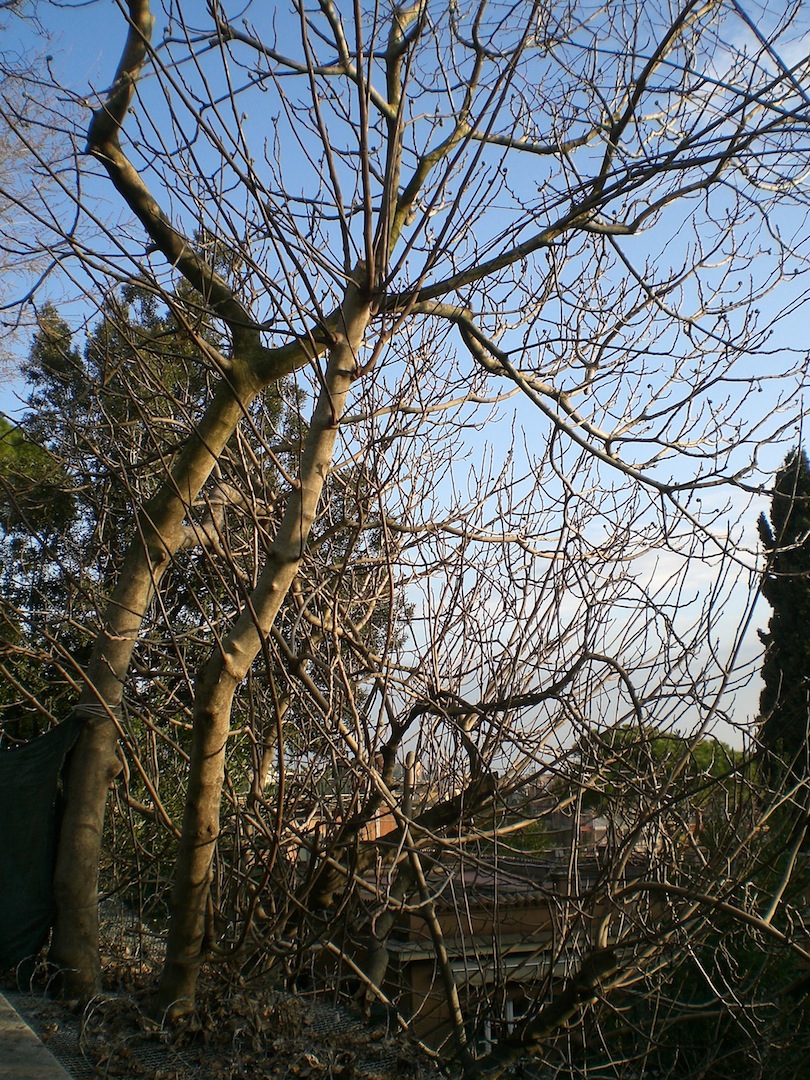
Approximately 20-foot tall fig trees at Radda in Chianti, Tuscany.
A close-up of the same fig tree in Radda.  I don't know what type of fig it is, but it was easily the most dense and multi-branched fig tree I've ever seen.  Hard to imagine enough light would reach the interior of the tree to ripen figs in the summer.
The fig tree is located right by the road.  You could easily harvest ripe figs from your car in the summer.
I spotted this beautiful blooming tree at a local ceramic maker's shop in Tuscany.  I couldn't figure out what it was until I saw the remnants of the previous year's bounty on the ground beneath the tree.  Almonds!
Almond blossoms. Bees were buzzing about the tree pollinating the flowers.
More almond blossoms clustered together with the ceramic shop in the background.
Grape vines across the street and up the hill from the ceramic shop.  Trellised vines as far as the eye could see, all over the countryside.
I don't know hold old these vines are.  They were not the youngest or oldest vines I saw, but were probably somewhere in the middle.
They prune the vines to maintain growth and productivity.
Close-up of recently pruned grape vine.
The skyline of the small medieval town of San Gimignano in the provence of Siena, Tuscany.  It was a cold and cloudy day.  Note the very large fig tree in the lower left-hand corner of the picture.  
Close-up of the large fig tree in San Gimignano.  Note the old wooden ladder leaning against the trunk of the tree.  I wish I was there in the summer to climb the ladder and sample the fresh figs.
I hope you made it to the end of this post without being bored out of your mind.  Yes, the art, architecture, and culture of Italy are out of this world.  But at the same time, the variety and abundance of plants nestled within this historic setting are no less impressive and equally as beautiful.


Wednesday, February 16, 2011

A Berry Good Trellis

I hate to admit it, but prior to 2009 I had never eaten fresh raspberries or blackberries off the vine.  At least not when I was old enough to remember it.  I had only eaten berries from the store with a flavor I would describe as "meh, average".  Two years ago I decided to visit a nearby pick-your-own berry operation (Barry's Berries and Jan's Jams at Rose Tree Hill Farms) about an hour from the house.  I thought it would be fun to pick berries.  I was absolutely blown away when I tasted fresh raspberries and blackberries right off the vine.  I knew at that moment I would one day plant cane berries in my backyard.  I didn't have a choice.  The flavor of the berries compelled me!

Last spring, I planted a few different varieties of berries down one side of my yard.  I selected Heritage Red raspberries (3 plants), Fall Gold raspberries (2 plants), Ouachita blackberries (3 plants), Arapaho blackberries (1 plant), and Triple Crown blackberries (1 plant).  They were young plants from small containers, and they grew fairly well. The raspberries even produced a few handfuls of berries.  The blackberries did not because they only fruit on second year canes. They are also thornless varieties.

As they grew, they started to bend over.  Most of them were either growing along the ground or close enough that when it rained they would be covered in mud.  I had other projects to work on at that time, and building a berry trellis was low on my priority list.  I just wanted the plants to establish a good root system.

Last weekend I set three 4"x4" posts 30" deep in the ground.  I placed a shovel-full of coarse gravel at the base of each hole to help with drainage and used a bit of quick setting concrete in each hole.  I pre-drilled the edge posts with holes for hardware and drilled holes all the way through the middle posts where I could run the wire rather than attaching more hardware.

Three-tier berry trellis for blackberries and raspberries.
I used galvanized wire (can't remember what gauge) and turnbuckles to put appropriate tension on the wire.  It's nearly impossible to hand-tighten 30-feet of fairly substantial wire.  Just can't do it.  The turnbuckles make it an easy chore and I can adjust them at a future date if I need to. Why wire, turnbuckles, and other heavy duty stuff? The plants will eventually be so heavy with fruit that anything less would sag and eventually fail.

Turnbuckle.
Additional hardware to keep the other end of the wire from slipping.
I repeated this same setup for each strand of wire.  The first wire is roughly 18" off the ground, the second is close to 36", and the third wire is close to 60" high to provide even support.  I then carefully lifted the blackberry canes and loosely tied them to the wire.  I did the same with the raspberries (which grow shorter than the blackberries), and was careful with them to avoid the tiny little spines/spikes all over each cane.  I still need to paint the posts to protect them from the elements.  Aside from that, the trellis is basically complete.

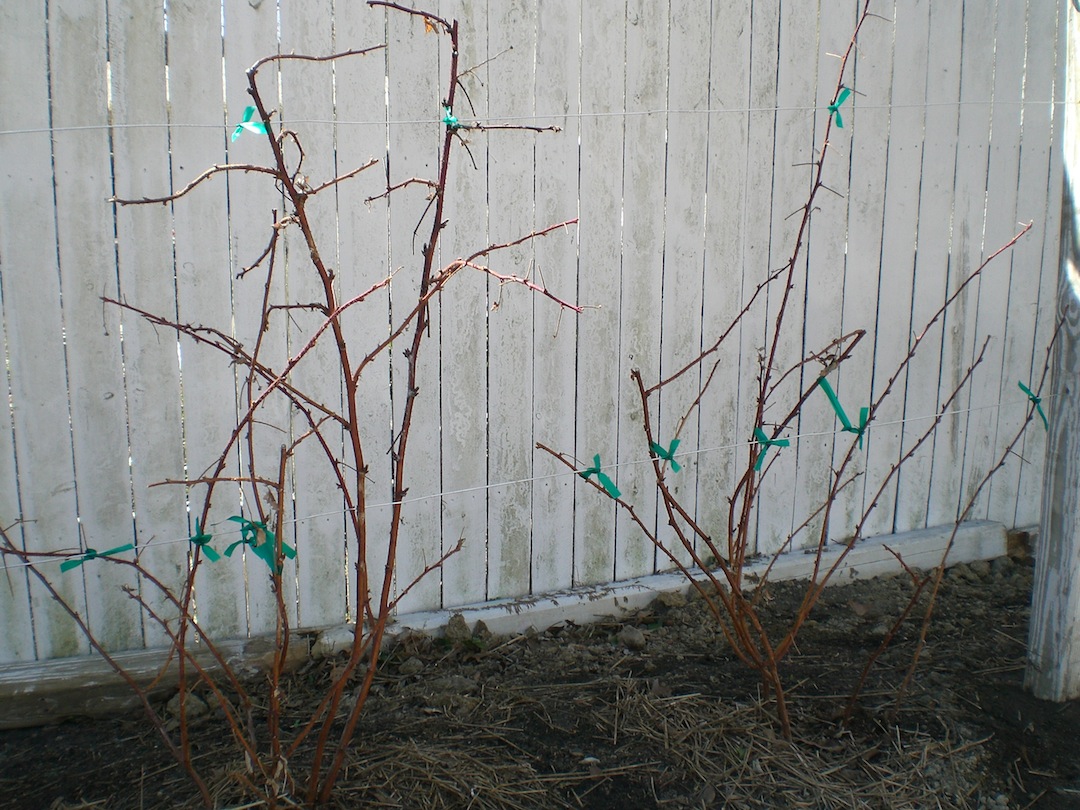
Heritage Red raspberries loosely tied to the first and second tier of the berry trellis.
Ouachita blackberry plant attached to the trellis.
Although I call it a "berry good trellis", it may not necessarily be the best trellis.  The varieties of blackberries I planted are biennial.  This means that the first year of growth for each cane doesn't produce berries.  They only flower and fruit the second year.  How does that impact the trellis design?  Well, it would probably be easier if I had two separate sets of wires.  I would tie new canes to one set and harvest fruit from second year canes on a separate set of wires and repeat each year.  I will probably end up letting the new canes grow and trail, and I'll only tie them to the trellis after I have harvested berries and removed the second year canes in the fall.  The raspberry varieties I planted are everbearing, meaning they produce fruit in the summer on second year canes, and in the fall on first year canes.  I will tie all raspberry canes to the trellis.

There's one additional advantage to the trellis.  It'll be alot harder for my dogs to pull berries off the plants.  I caught both dogs eating raspberries off the canes last fall.  The sweet berries must've been worth the pain because those raspberry canes are sharp!

And here's one last thought.  If you've never eaten a fresh yellow/gold raspberry, try to find a place that grows them.  Your taste buds will thank you.