Showing posts with label Blackberries. Show all posts

Sunday, March 18, 2012

March Madness

The madness has set in. Not college basketball madness. I'm talking spring garden madness. Average temps have been consistently warm for the past few weeks, and I think the plants in the yard believe it is April. Enjoy the following picture tour of March Madness at .09 Acres:

Still harvesting Chantenay Red Core carrots from the garden.
This 18.5 oz carrot dwarfed the 14.1 oz carrot I harvested 2 months ago. I don't have the largest hands, but this octopus-like carrot is ridiculous. This carrot is grown from seed I purchased from Southern Exposure Seed Exchange (SESE).
Japanese maple waking up from winter slumber. This tree was a seedling from parent's old house in Virginia Beach. I also gave a second seedling (now about 8 feet tall) to my friends Elsa and Matt in Norfolk.
Gardeners know that mint is extremely invasive. Here is a half-barrel of mint scrambling for more real estate. 
Rosemary. Yum.
Rosemary blooms. Yum?
Cold hardy mache appears as if it will be going to seed very shortly. It doesn't like hot weather.
Arugula in full bloom. I save seed from this plant every year. It's very easy. Just wait for the seed pods to dry on the plant, then cut the flower stalk and shake the dry pods in a brown bag. Voila! Seeds!!
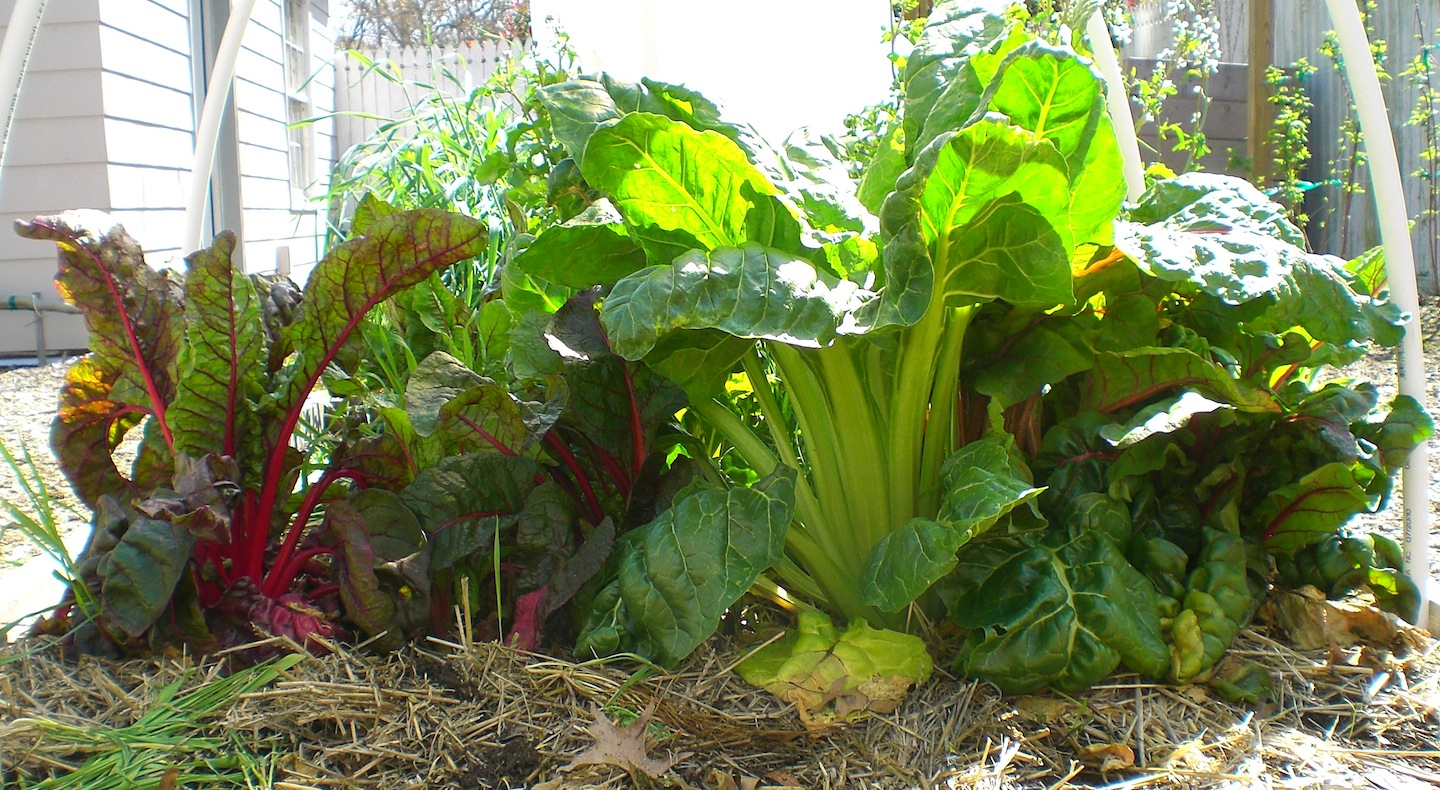
A 4-foot row of various Swiss Chard. This stuff is versatile in the kitchen and grows in all weather conditions.
Ruby Red Chard from SESE.
Kale. I grew my kale exposed all winter. No plastic, floating row cover, or hoop house. Resilient for sure. Try kale soup with chorizo. You won't be disappointed.
Red bunching onion grown from SESE seed sown last fall.
This Calabrese broccoli is destined for pasta with olive oil and garlic.
Winter Density has been the top lettuce producer in my garden for the past two years. The only problem I have is dealing with slugs and aphids that crawl inside the wrinkly leaves. Nothing a little water won't solve.
A row of trellised Fall Gold, Kiwi Gold, and Heritage Red raspberries. These are a must-grow in the Mid-Atlantic and Tidewater area.
Thornless Ouachita blackberries busting loose.
Potted lemon tree preparing to bloom. Looking forward to a better citrus harvest in 2012-13. This past year was disappointing. I only harvested a handful of lemons and limes.
Russian Red Pomegranate (8 feet tall) from Edible Landscaping in Afton, VA.
Russian Red Pomegranate leaves reaching for the sun.
Celeste fig tree (appx. 6 years old) from the now-closed Paradise Nursery. I've pruned this every year in order to encourage a low, wide shrub-like growth. More branches = more figs.
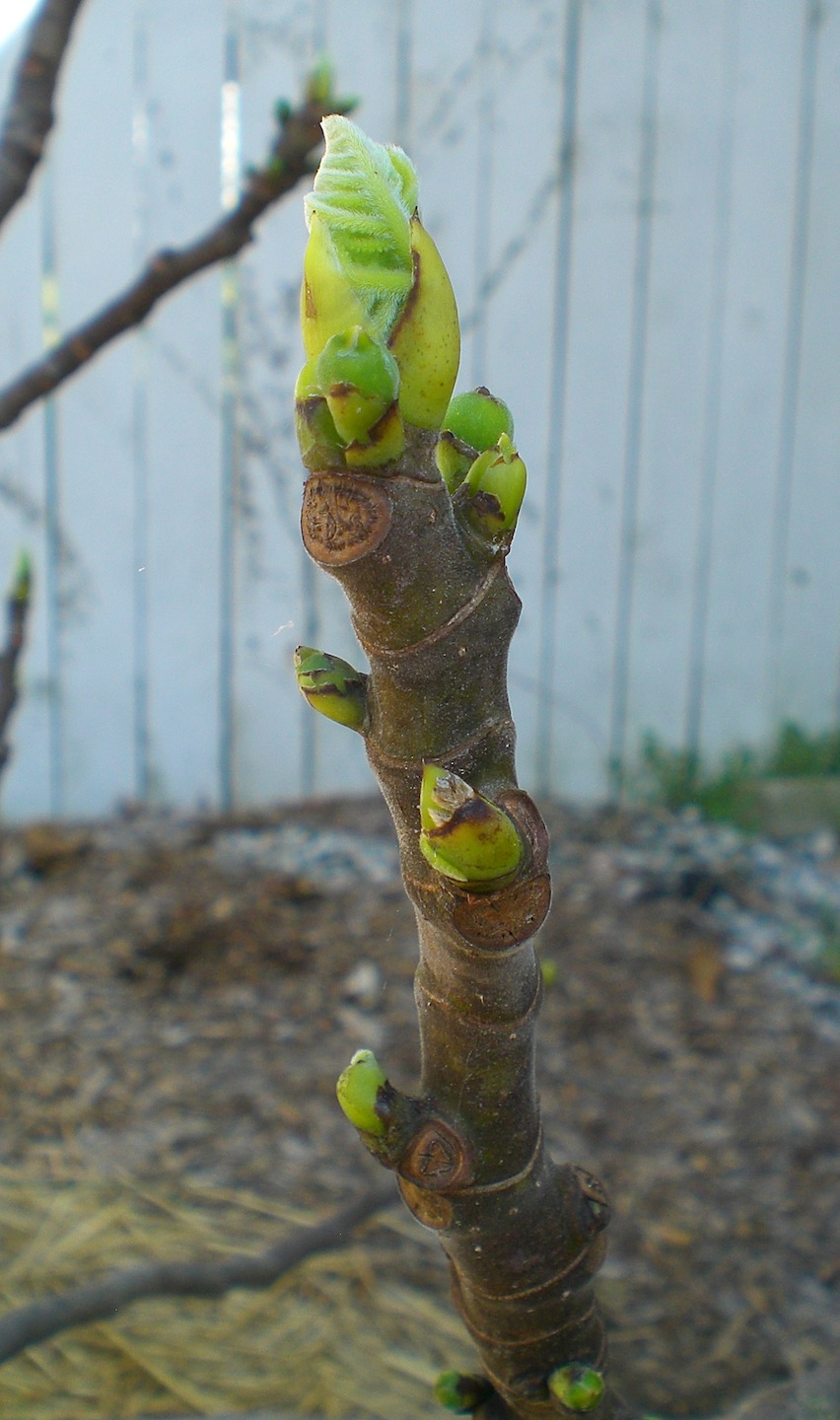
The tip of a Celeste fig tree branch. Notice the combination of new leaves and tiny figs. Some varieties of figs produce 2 harvests per year. The early figs are called brebas.
Another view of the Celeste fig tree. Note the multiple growths on each branch. If I didn't prune, I would have a tall, lanky tree rather than a dense shrub.
My fig espalier at the corner of my garden shed. 3 days ago I pruned off all of last year's vertical growth near the two main horizontal arms. I left a single vertical node from last year's growth in order to allow the new branches to grow from those same locations this year. I will repeat this process year after year. Grow, harvest, prune. Grow, harvest, prune.
Detailed photo of a vertical node extending from a horizontal branch of the Celeste fig espalier. New growth will appear on the rough area of the top portion of the vertical node. New growth will also likely appear elsewhere, but I will prune or rub off the new growth before it negatively impacts the desire appearance of the overall espalier. 
I hope you enjoyed your tour of March Madness at .09 Acres. My apologies for not posting here more consistently during the past few weeks. Work has been eating me alive, and it's great to be back outside again. Wishing you good growing and great harvests in your gardens!

Friday, September 30, 2011

Late September

Late September at .09 Acres is a transitional period in the garden. The fig trees are lush and still loaded with a secondary crop of figs, reminiscent of mid-summer flavors. The slightly cooler weather, ripening pomegranates, and newly planted lettuce and spinach seedlings welcome the arrival of fall.

I put together this photo-mosaic on September 29 to give you an idea of what's taking shape in the yard. Please disregard the sunbathing hairless terrier lounging between the raised beds.

September at .09 Acres in Newport News, Virginia.
If you compare this picture with the main photo in the banner of my blog, you'll notice some pretty significant changes. The fig trees are quickly filling out against the south-facing fence (left). The espalier fig is reaching for the sky agains the shed (back left, near center). The raspberries and blackberries are looking a bit rough after the hot summer (back right). The peach tree has been replaced by 3 small rabbiteye blueberry bushes (right). I've found that peaches are nearly impossible to grow organically in this climate. And the pomegranate tree is flourishing (near right). I've also kept the grass and weeds in check with diligent digging, weeding, and mulching.

The raised vegetable beds look nearly naked, with the exception of a few emerging seedlings. You can see beet and carrot seedlings mid left and lettuce planted at staggered intervals near right. Within 30-45 days I'll be harvesting lettuce, spinach, radishes, and chard. I also plan on covering most beds with hoop houses to extend the growing season. They will also act like outdoor refrigerators keeping plants growing slowly but well preserved even during periods of frost and snow.

Thursday, June 9, 2011

Early June

I'm back.  It's been almost 2 months since my last post.  Too long. Figured I'd do a big pictures post from the yard.  It's been an interesting and productive Spring, with a few setbacks as well. Generally speaking the garden is doing great.  Let's start with the good then I'll move on to the bad and ugly.  I successfully saved seed from my Vates kale and two varieties of Swiss chard.  They get tall when they bloom.  I'm talking 6-feet tall!  I added about 4" of fresh compost to each bed and built a small extension designated for herbs. Cucumber production has been nothing short of amazing.  I've got 5 Burpless plants in the ground and I'm pulling about 8 cukes/day.  I planted borage as a companion plant to my tomatoes, and it  is growing very well.  Beautiful flowers and they are edible too.  Peaches are hanging from the tree, the pomegranate is still in bloom. Raspberries were a tasty treat for about 3 weeks and are slowing now, but the blackberries are starting to kick in.  Figs have also put on new growth and, more importantly, many figs.  Not as many as I hoped for, but I pruned them back in early spring to encourage more branching for larger future harvests.  The fig espalier is developing fairly well.  I also just finished harvesting approximately 50 heads of Inchelium Red garlic and they are drying in my shed.  That's a short version of the good.

Now for the bad.  My precious, beloved, sacred, and coveted heirloom tomatoes are taking a beating.  They grew well for the first 6 weeks after I transplanted them into the garden, and they grew large.  I'm talking appx. 4-5 feet tall.  Then I started noticing what I believe to be blight.   It first appeared on a few leaves, then a stem, a truss of tomatoes, an entire stalks.  I quickly pruned those areas, sterilized my pruners, and then moved to the next plant.  But it kept moving.  So this past weekend and evening I ripped out 5 of my 7 in-ground tomatoes.  2 German Johnson, 1 Black from Tula, 1 Bull's Heart, and 1 Marvel Striped. I don't know why it hit so hard.  I immediately tossed them in the garbage bin.  I've been careful about watering, 2 doses of organic foliar feed (spaced 4 weeks apart) in the early morning, etc. etc., but I guess a large harvest like last year wasn't meant to be.  I'm planning on purchasing a few more plants and probably dropping in a few seeds as well, but I'm flat out bummed.

And the ugly.  Despite my best attempt at smothering the grass, it's back.  And lots of it.  Multiple layers of cardboard, 4-5 inches of mulch, periodic hand weeding of the errant shoot of grass, all for nothing.

Alright, enough gibberish!  Let's do the photos, shall we?
This is a mix of the good and the ugly.  Figs down the left, raised beds front and center, berries/peach/pomegranate on the right.  Oh yeah, and grass everywhere...son of a...
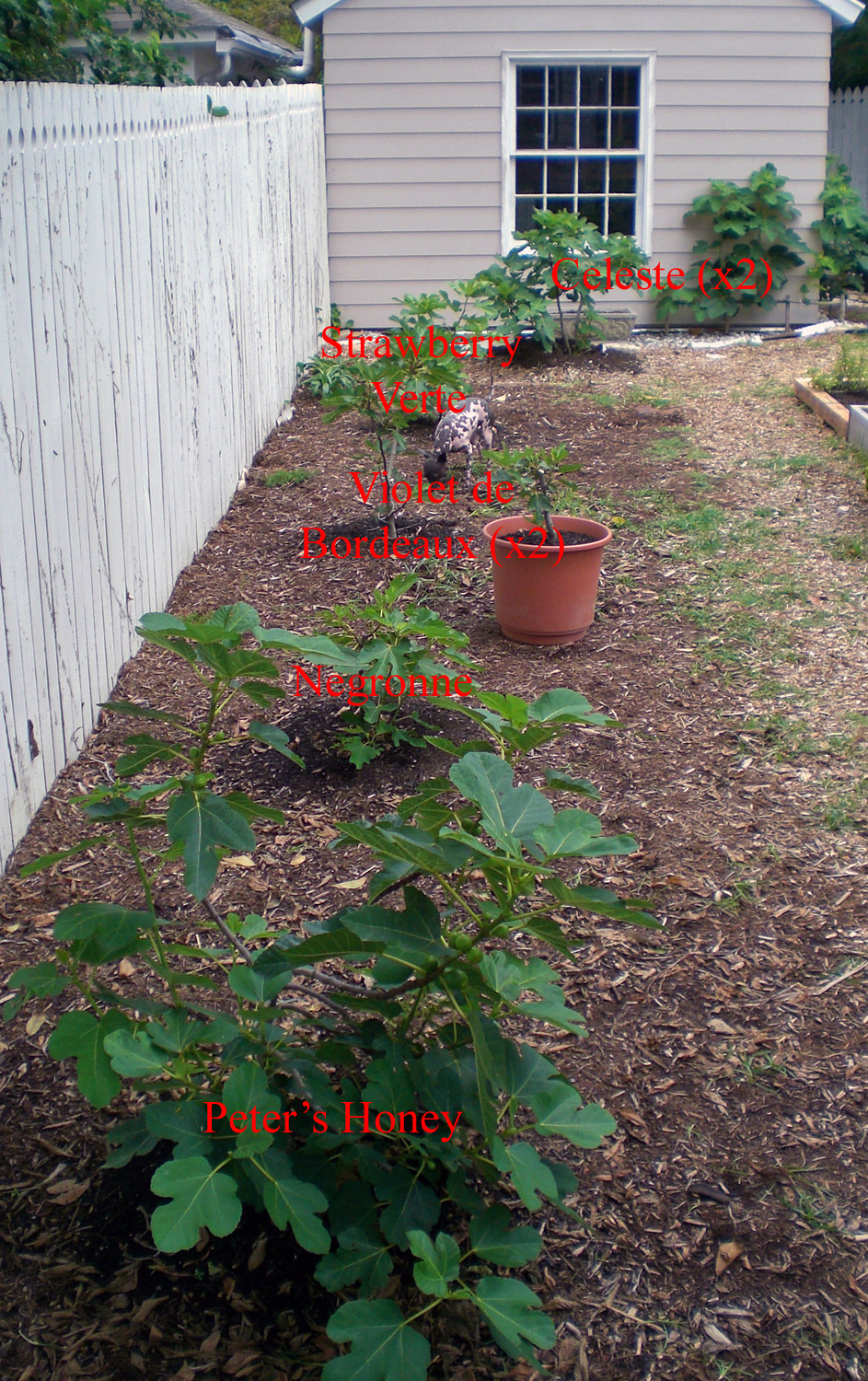
Row of figs down the left wall of the yard.  They are all fairly small, but are adapting well to their permanent location.  I grow a mix of brown, purple, and green figs.   If you look closely, you can spot Scout.  She's the hairless wonder dog.
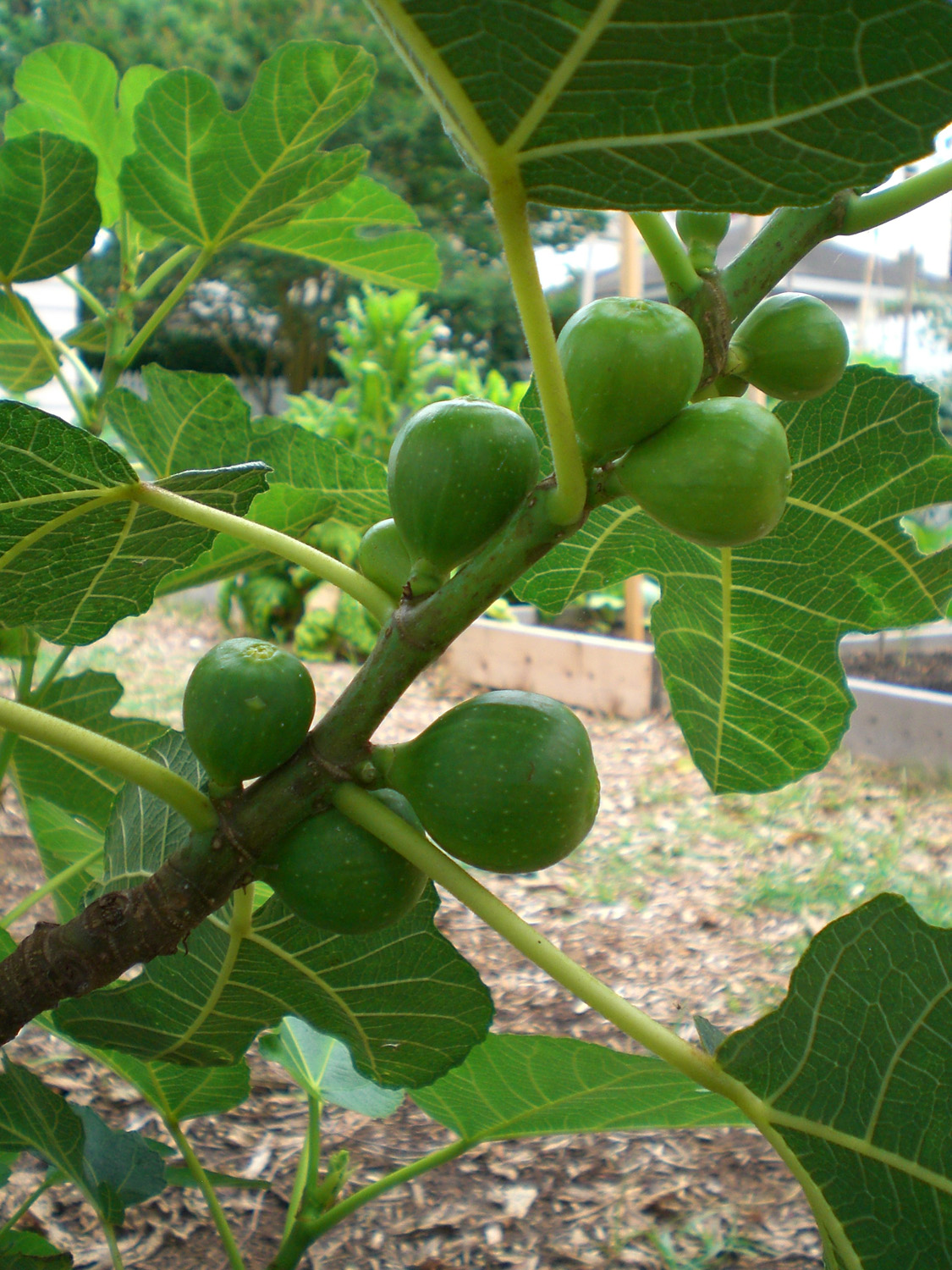
Peter's Honey fig.  In some areas this plant is putting out 2 figs per leaf, and I don't think that's very common. I'm not complaining.
Violet de Bordeaux figs.  I will pick individual ants off the tree to protect these, partly because I'm crazy but mostly because these things are heavenly.
The Red Haven peach tree is getting very large.  I pruned it heavily this winter and again about 3 weeks ago, and it keeps on growing.  I also thinned the fruits a while ago, but it's still hanging about 25 peaches.
Overhead view of the Red Haven peach tree showing the main scaffold limbs.  I'm trying to maintain an open center to allow light in and air to circulate.
I haven't sprayed this tree with a single thing this year and it still looks healthy.  I hope that holds up for the rest of the year.
The Russian Pomegranate also likes its sunny but sheltered location.  It's approximately 7' x 7' and was covered in blooms for 3 weeks.
A tiny pomegranate and a few blooms in the background.
This is a young Haku-Botan pomegranate tree, courtesy of Sybil Mays.  It will eventually produce yellow/gold pomegranates.  Sybil, this is the little plant you dug up from your side yard.  It has recovered and grown ALOT!
It's a cucumber jungle out there.  By now they've established very deep roots and don't show much wilting during the hottest (98 degrees) driest weather this year.
These beasts make a mean cucumber salad.
Ouachita blackberries beginning to ripen.  I'm not sure exactly what happened (or didn't happen), but I think poor or incomplete pollination led to irregularly shaped berries.  Look closely in the picture and you'll see what I'm talking about.
Almost ready.
All the literature says that borage flowers have a cucumber taste.  I disagree.  They taste like borage flowers.  Not really cucumbery, but just a general leafy green pleasant flavor.  I grew these as a companion plant for the tomatoes, but it clearly hasn't helped this season.  
Don't ask me how this partially ripened black cherry tomato tasted.  I wouldn't know.  My dog Diego ate it so you'll have to ask him.  
When most people draw a picture of the devil, they draw a red devil.  The devil is NOT red.  The devil is green.  Check out this mix of Bermuda grass and some other green beasts that are growing well despite Operation Smother.
Bermuda grass a-creepin'.  This is the aforementioned ugly.  I plan on pulling everything I can by hand rather than using some ineffective organic herbicide or crazy poisonous herbicide.  I do not want to mow this back yard ever again.  
I'll post again soon with pictures of the garlic harvest as well as the fig espalier.  How are things growing in your gardens?  If you are fortunate enough to have a bumper crop of heirloom tomatoes later in the summer, I'll likely be begging at your front door. That's a promise.

Thursday, April 14, 2011

Happy First Birthday .09 Acres!

It's officially been one year since I built the first raised beds and planted a few berries in the ground at .09 Acres.  The time has flown by so fast.  But before I even dug a spade into the ground or removed a single overgrown vine, I was running through all the possibilities in my mind.

Let me go back a little earlier than a year ago.  I want to start with a few photos I took in September 2009, a month before we purchased the house.  The yard was nice....quiet, private, and ordinary.  It was the type of yard you'd expect to find in my neighborhood.

September 2009 at .09 Acres.
The main problem I saw was that the yard was the exact opposite of what I wanted in a yard.  Grass that needed to be mowed, fertilized, and edged.  Overgrown bushes, shrubs, and invasive vines and ground cover that needed to be tamed and maintained.  I didn't want any of that.  I wanted to create an edible landscape filled with veggies, fruits, and herbs.  No grass, raised vegetable beds, a variety of different fruit trees.  This couldn't be the place for me.  Or could it?

Despite the numerous drawbacks, the property offered many things I was looking for in a yard.  Full sun exposure for 8-10 hours per day.  A manageable size.  Privacy fencing that offered seclusion and also created a slightly warmer micro-climate.  And a fairly open layout that I could configure any way I wanted.  Maybe this was the right place!

We eventually purchased the house but I didn't dive into the yard until we had spent a few months working on some DIY renovations inside. I finally got out into the yard in early spring and pruned or removed many overgrown shrubs, bushes, and trees.  I ripped out the creeping groundcover, and even moved the fence closer to the property line to reclaim some additional footage (it all counts in a small yard!)  By that point it was April, 2010 and I was ready build some raised beds and plant some edibles.

April 2010 at .09 Acres.
You can see a large difference between September 2009 and April 2010.  I gained quite a bit of square footage by removing old plants and moving the fence.  I also pruned the grand old Japanese Maple (back left in the above photo).  Unfortunately I had to remove it later on after I discovered that its roots caused some major damage to some nearby plumbing.

I worked when I could.  An evening here, weekends there, official holidays, work holidays. I even dragged myself outside when I was sick to pull a weed or water a new plant.  It borders on obsession at this point.

Here we are one year after I built the first raised beds.  What does the place look like now?  To be quite honest, it looks a bit bare.  But I intentionally provided sufficient space between the fruit trees to allow them ample room to grow and thrive in the coming years.  And hopefully they will.  Now the peach tree and berries are growing like crazy, the young fig trees are starting to leaf out, and I'm preparing to plant new veggies in the raised beds.  Within a few weeks the whole yard will be alive.

April 2011 at .09 Acres.
I added labels to the picture to show what is planted in the yard.  I selected the left-most fence (facing south) for my fig trees.  I have 5 different varieties in the ground.  The berry trellis is near the right-most fence (facing north).  It still gets great sun during the day.  I tucked a peach tree and pomegranate tree closer to the house for protection against cold winter winds and to ensure that they would stay dormant just a little longer than usual to prevent against damage from a late frost.

The original 5 raised beds have been joined together.  I added the rough overall dimensions of these long beds to give an idea of how much produce I can grow.  I opted for raised beds because the ground is very low and drains slowly after a good rain.  I also smothered the grass and weeds with layers of cardboard and mulch.  I'm not sure how effective that will be over the long haul.  Only time will tell.

I didn't really know what creating an edible landscape would take in terms of time, labor, and expense, but I went for it.  By no means am I done, but I've accomplished quite a bit.  I know the yard will continue to change and evolve.  I'll have more successes and setbacks, more elation and deflation (is that a word?), and that's what makes it exciting.  Equally exciting is the pride and enjoyment of harvesting a basket of ripe heirloom tomatoes, watching figs ripen in the sun, and plucking sweet raspberries and blackberries off the trellis.  Sure beats mowing the lawn, doesn't it?!

Wednesday, February 16, 2011

A Berry Good Trellis

I hate to admit it, but prior to 2009 I had never eaten fresh raspberries or blackberries off the vine.  At least not when I was old enough to remember it.  I had only eaten berries from the store with a flavor I would describe as "meh, average".  Two years ago I decided to visit a nearby pick-your-own berry operation (Barry's Berries and Jan's Jams at Rose Tree Hill Farms) about an hour from the house.  I thought it would be fun to pick berries.  I was absolutely blown away when I tasted fresh raspberries and blackberries right off the vine.  I knew at that moment I would one day plant cane berries in my backyard.  I didn't have a choice.  The flavor of the berries compelled me!

Last spring, I planted a few different varieties of berries down one side of my yard.  I selected Heritage Red raspberries (3 plants), Fall Gold raspberries (2 plants), Ouachita blackberries (3 plants), Arapaho blackberries (1 plant), and Triple Crown blackberries (1 plant).  They were young plants from small containers, and they grew fairly well. The raspberries even produced a few handfuls of berries.  The blackberries did not because they only fruit on second year canes. They are also thornless varieties.

As they grew, they started to bend over.  Most of them were either growing along the ground or close enough that when it rained they would be covered in mud.  I had other projects to work on at that time, and building a berry trellis was low on my priority list.  I just wanted the plants to establish a good root system.

Last weekend I set three 4"x4" posts 30" deep in the ground.  I placed a shovel-full of coarse gravel at the base of each hole to help with drainage and used a bit of quick setting concrete in each hole.  I pre-drilled the edge posts with holes for hardware and drilled holes all the way through the middle posts where I could run the wire rather than attaching more hardware.

Three-tier berry trellis for blackberries and raspberries.
I used galvanized wire (can't remember what gauge) and turnbuckles to put appropriate tension on the wire.  It's nearly impossible to hand-tighten 30-feet of fairly substantial wire.  Just can't do it.  The turnbuckles make it an easy chore and I can adjust them at a future date if I need to. Why wire, turnbuckles, and other heavy duty stuff? The plants will eventually be so heavy with fruit that anything less would sag and eventually fail.

Turnbuckle.
Additional hardware to keep the other end of the wire from slipping.
I repeated this same setup for each strand of wire.  The first wire is roughly 18" off the ground, the second is close to 36", and the third wire is close to 60" high to provide even support.  I then carefully lifted the blackberry canes and loosely tied them to the wire.  I did the same with the raspberries (which grow shorter than the blackberries), and was careful with them to avoid the tiny little spines/spikes all over each cane.  I still need to paint the posts to protect them from the elements.  Aside from that, the trellis is basically complete.

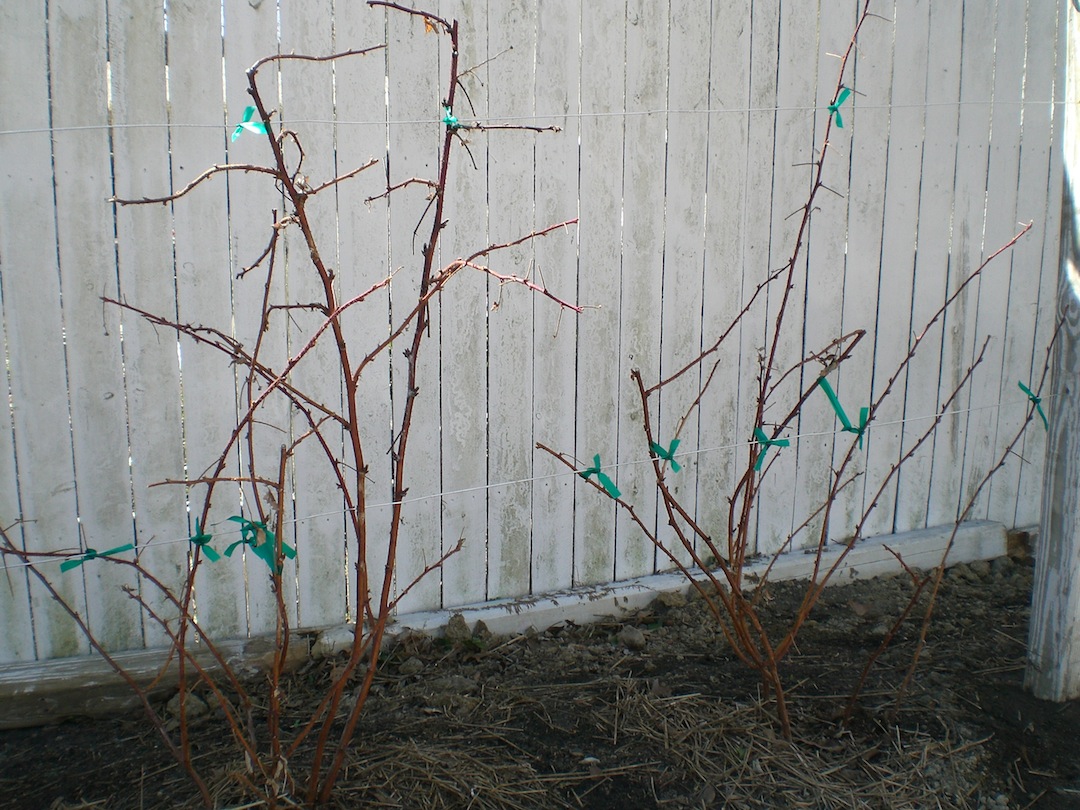
Heritage Red raspberries loosely tied to the first and second tier of the berry trellis.
Ouachita blackberry plant attached to the trellis.
Although I call it a "berry good trellis", it may not necessarily be the best trellis.  The varieties of blackberries I planted are biennial.  This means that the first year of growth for each cane doesn't produce berries.  They only flower and fruit the second year.  How does that impact the trellis design?  Well, it would probably be easier if I had two separate sets of wires.  I would tie new canes to one set and harvest fruit from second year canes on a separate set of wires and repeat each year.  I will probably end up letting the new canes grow and trail, and I'll only tie them to the trellis after I have harvested berries and removed the second year canes in the fall.  The raspberry varieties I planted are everbearing, meaning they produce fruit in the summer on second year canes, and in the fall on first year canes.  I will tie all raspberry canes to the trellis.

There's one additional advantage to the trellis.  It'll be alot harder for my dogs to pull berries off the plants.  I caught both dogs eating raspberries off the canes last fall.  The sweet berries must've been worth the pain because those raspberry canes are sharp!

And here's one last thought.  If you've never eaten a fresh yellow/gold raspberry, try to find a place that grows them.  Your taste buds will thank you.