Showing posts with label Pomegranates. Show all posts

Sunday, March 18, 2012

March Madness

The madness has set in. Not college basketball madness. I'm talking spring garden madness. Average temps have been consistently warm for the past few weeks, and I think the plants in the yard believe it is April. Enjoy the following picture tour of March Madness at .09 Acres:

Still harvesting Chantenay Red Core carrots from the garden.
This 18.5 oz carrot dwarfed the 14.1 oz carrot I harvested 2 months ago. I don't have the largest hands, but this octopus-like carrot is ridiculous. This carrot is grown from seed I purchased from Southern Exposure Seed Exchange (SESE).
Japanese maple waking up from winter slumber. This tree was a seedling from parent's old house in Virginia Beach. I also gave a second seedling (now about 8 feet tall) to my friends Elsa and Matt in Norfolk.
Gardeners know that mint is extremely invasive. Here is a half-barrel of mint scrambling for more real estate. 
Rosemary. Yum.
Rosemary blooms. Yum?
Cold hardy mache appears as if it will be going to seed very shortly. It doesn't like hot weather.
Arugula in full bloom. I save seed from this plant every year. It's very easy. Just wait for the seed pods to dry on the plant, then cut the flower stalk and shake the dry pods in a brown bag. Voila! Seeds!!
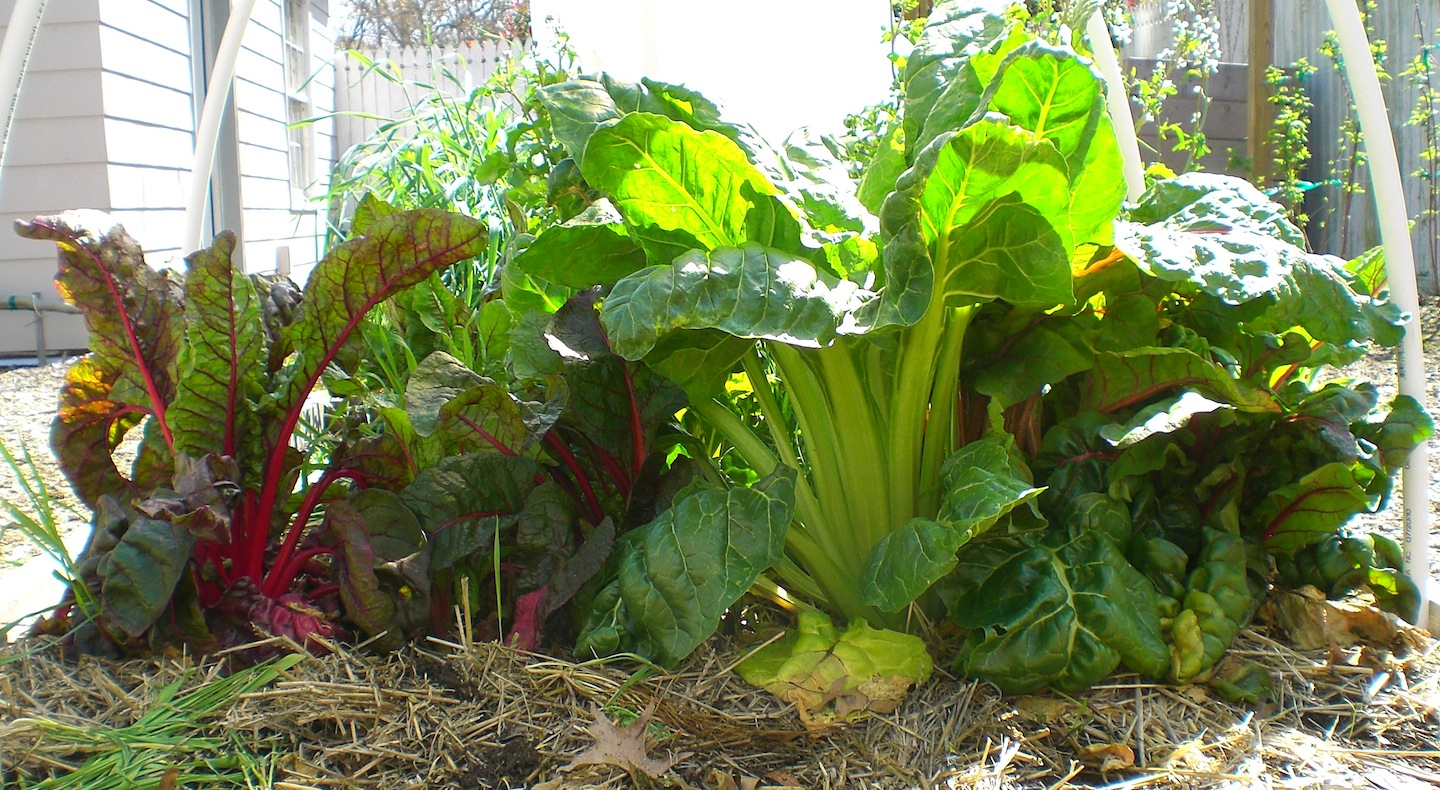
A 4-foot row of various Swiss Chard. This stuff is versatile in the kitchen and grows in all weather conditions.
Ruby Red Chard from SESE.
Kale. I grew my kale exposed all winter. No plastic, floating row cover, or hoop house. Resilient for sure. Try kale soup with chorizo. You won't be disappointed.
Red bunching onion grown from SESE seed sown last fall.
This Calabrese broccoli is destined for pasta with olive oil and garlic.
Winter Density has been the top lettuce producer in my garden for the past two years. The only problem I have is dealing with slugs and aphids that crawl inside the wrinkly leaves. Nothing a little water won't solve.
A row of trellised Fall Gold, Kiwi Gold, and Heritage Red raspberries. These are a must-grow in the Mid-Atlantic and Tidewater area.
Thornless Ouachita blackberries busting loose.
Potted lemon tree preparing to bloom. Looking forward to a better citrus harvest in 2012-13. This past year was disappointing. I only harvested a handful of lemons and limes.
Russian Red Pomegranate (8 feet tall) from Edible Landscaping in Afton, VA.
Russian Red Pomegranate leaves reaching for the sun.
Celeste fig tree (appx. 6 years old) from the now-closed Paradise Nursery. I've pruned this every year in order to encourage a low, wide shrub-like growth. More branches = more figs.
The tip of a Celeste fig tree branch. Notice the combination of new leaves and tiny figs. Some varieties of figs produce 2 harvests per year. The early figs are called brebas.
Another view of the Celeste fig tree. Note the multiple growths on each branch. If I didn't prune, I would have a tall, lanky tree rather than a dense shrub.
My fig espalier at the corner of my garden shed. 3 days ago I pruned off all of last year's vertical growth near the two main horizontal arms. I left a single vertical node from last year's growth in order to allow the new branches to grow from those same locations this year. I will repeat this process year after year. Grow, harvest, prune. Grow, harvest, prune.
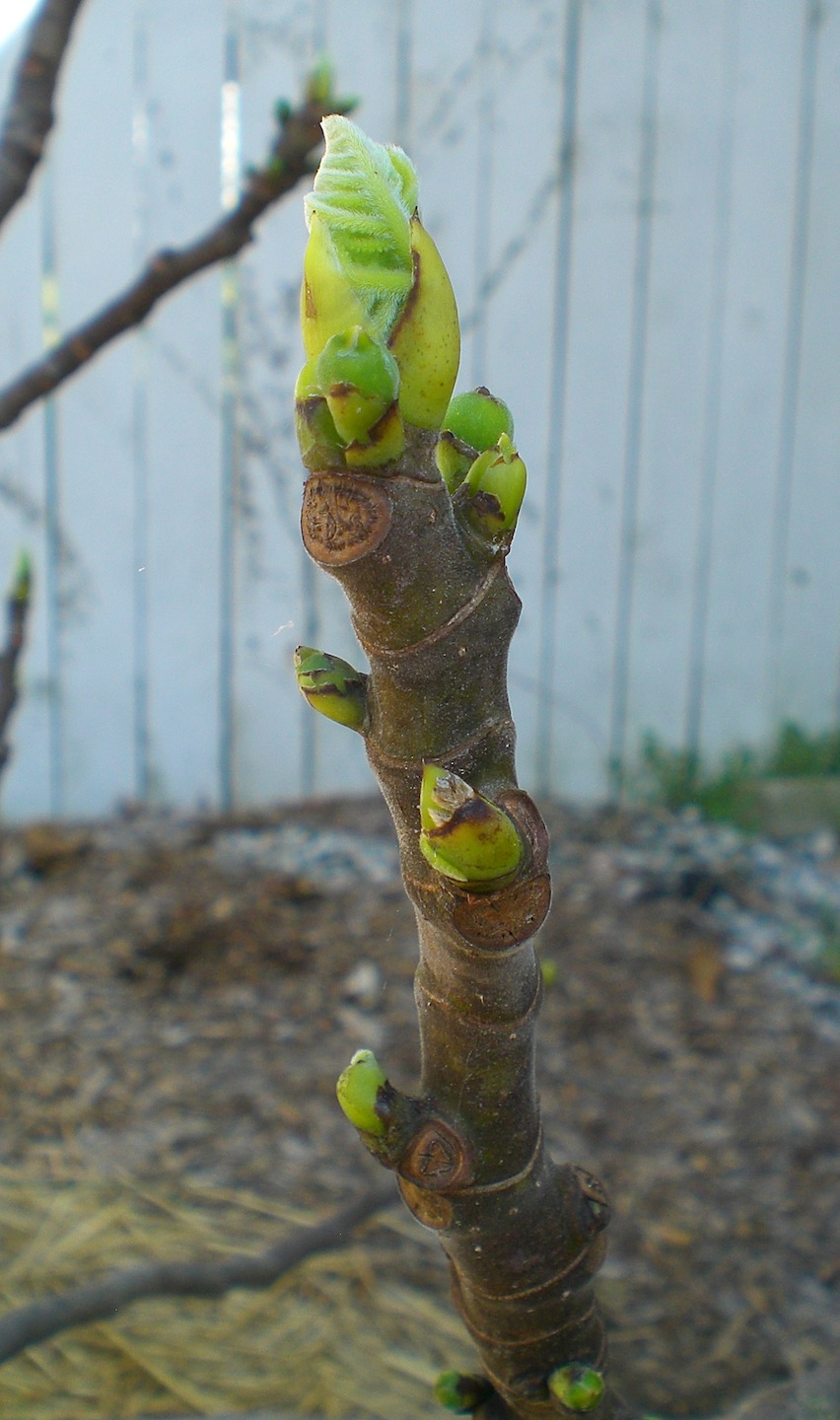
Detailed photo of a vertical node extending from a horizontal branch of the Celeste fig espalier. New growth will appear on the rough area of the top portion of the vertical node. New growth will also likely appear elsewhere, but I will prune or rub off the new growth before it negatively impacts the desire appearance of the overall espalier. 
I hope you enjoyed your tour of March Madness at .09 Acres. My apologies for not posting here more consistently during the past few weeks. Work has been eating me alive, and it's great to be back outside again. Wishing you good growing and great harvests in your gardens!

Monday, December 12, 2011

A Jekyll and Hyde December

.09 Acres is having an identity crisis this December, and I fear that Dr. Henry Jekyll and Mr. Edward Hyde are living in my garden shed.

Dr. Jekyll and Mr. Hyde in the well-appointed garden shed at .09 Acres. Image courtesy of Wikipedia.

Let's start with Dr. Jekyll, shall we?! The vegetables at .09 Acres are much like Jekyll. They are mature and respectable. The lettuces and chard are good looking, tasty, and protected by the mini hoop house. The carrots, beets, and broccoli are doing just fine while prominently exposed to the elements. At this point in the year, they are all content in their beds until harvest. I'm not one to boast, but my greens look like they belong in a gardening catalog. If you were to walk by the lettuce bed, you might even respectfully tip your cap as if you were passing Dr. Jekyll on the street.

On the flip-side, my fruit trees, shrubs, and brambles are behaving in an irrational and unpredictable Hyde-like fashion. The inconsistent weather, much like Mr. Hyde's strange potions, is triggering all kinds of strange reactions from the plants. Raspberries continue to mature on a  semi-regular basis almost like it's early fall. The Celeste fig tree and espalier dropped all their leaves weeks ago. In contrast, my Violette de Bordeaux and Negronne fig trees are still covered in leaves and figs. It is quite grotesque to see them growing side-by-side. My Red Russian pomegranate is the only "normal" tree in the yard, having gone dormant in November. But who knows...it may be inwardly lusting for some sinister transformation.

A little bit of Jekyll, but certainly a lot more of Hyde at .09 Acres.

If .09 Acres is Dr. Jekyll (and Mr. Hyde), I guess that makes me Jekyll's loyal servant Poole. This December I've been out in the yard early in the morning and late in the evening to cover the greens in plastic. I've also changed quite a few things in the yard to keep Jekyll happy and productive. I dug up and potted my in-ground blueberry bushes and replaced them with a young Angel Red pomegranate tree (visible on right side of above picture in middle of straw mulch). I also transplanted a Peter's Honey fig and an unknown fig from my yard to my aunt and uncle's property and replaced them with Strawberry Verte and Hardy Chicago figs (visible on left side of above picture in middle of straw mulch).

Hopefully this will decrease the likelihood that Mr. Hyde shows up again at .09 Acres, but I may be losing my mind in the process...

Tuesday, November 15, 2011

Pomegranates: What a Difference a Year Makes

Last year around this time, I was really excited when I harvested 3 pomegranates from my Russian Red pomegranate tree. That tiny first harvest may not seem like a big deal to you, but it was a big deal to me. I felt like my little tree that I carefully grew and nurtured for a few years just graduated from grade school. It experienced some growing pains, but learned the basic skills it needed to survive.

What a difference a year makes! Last Sunday, I was beaming with pride as I harvested 24 pomegranates from the same tree. This was no small-time graduation...this was the equivalent of graduating from Harvard with honors.

Basket loaded with freshly harvested Russian Red pomegranates.
The pomegranates are not as large as varieties you typically find in a grocery store, but they do the trick.

Fist full o' pomegranates.
The pomegranate arils (seed casings) have a dark, rich color and the perfect balance of sweetness and tartness.

Pomegranate arils.
And with a little sweat and patience balanced with a dash of swearing, these pomegranates made great juice. Much better than commercial juice, no fooling. Check it out.

Freshly made pomegranate juice. No sugar required, 100% natural.
Beware, many pomegranates were harmed in the making of this juice. My entire harvest of pomegranates only made about 2 quarts of juice.

But that only made me wonder what next year's harvest will produce...

Thursday, November 3, 2011

Enjoying the Fall Garden

Like many people, I started out as a spring and summer vegetable and fruit gardener. Warm weather meant planting and harvesting. Cold weather meant waiting for next year's harvest.

It took me a few years and lots of trial and error to realize that cool season gardening can sometimes be the most rewarding gardening of all. The most notable differences between fall and summer gardening in Zone 7b are comfortable temps, very few bugs and pests, care-free veggies, and generally easy tasks. 

In its simplest form, fall gardening consists of sowing seed (in late summer), watering, mulching, more watering, and harvesting. That's just about all there is to it. Some hardier crops even survive repeated frosts and in a location like Newport News, VA, a productive four season garden is a realistic goal. 

I took the following photos of my fall garden at .09 Acres on Halloween, 2011.  

Long rows of Buttercrunch and Winter Density lettuce.
Young Rouge d'Hiver lettuce sown in succession with other lettuce varieties to extend the harvest. Succession planting spreads out the harvest over a few weeks or months.
Long Standing Bloomsdale spinach. This is my first attempt at growing spinach. I found that warmer soil temps in late September definitely hindered germination, but the spinach seems much happier in early November.
I had spotty germination of my carrots. Notice that the center two rows filled out nicely while the outer rows (far left and far right) are fairly sparse. I'll have to wait and see how they do this year. Last year was an amazing year for carrots.
It's tough to beat good beets. Here are four short rows of Detroit Dark Red and Chioggia beets. These are still quite young and probably need another month to grow. I thinned them in mid-October to allow the beet roots to grow larger, and I added the thinned greens to a salad. Definitely a great addition.
I am growing kale from seeds I saved (this spring) from last years kale plants. I battled tiny caterpillars for a few weeks when the plants were young, and you can see some of the leaf damage they caused in this picture. 
I am growing broccoli in two large pots and in a raised bed. I'm curious to see whether it grows better in-ground or in the pots. I can't remember if I planted Calabrese or Waltham broccoli. I have to check my seek packet. I may have started these seeds too late for the plants to mature in time to produce harvestable broccoli, but only time will tell. The tiny caterpillars that hit my kale also like the broccoli. Damage is visible on the right-most leaf.
Apple mint growing in half a wine barrel near the gate to my yard. It has made an amazing comeback from the crippling heat of mid-summer. This plant thrives in mid-late spring, suffers through summer, then regrows with a vengeance in fall. This entire barrel grew from a small rooted cutting I dug up from a yard where I previously lived. Mint will take over the world if it's not contained, but it's also a must-have in any yard.
Russian Red pomegranate ready for harvest. There are appx. twenty of these hanging from my 4-year old pomegranate tree. I can't say enough good things about this tree.
Negronne figs that definitely will not have enough time to ripen before the first frost. This tree keeps growing larger and producing more figs. Next year should be an amazing harvest. 
Two unripe Eureka lemons hanging from a small branch on my potted tree.
New foliage on my Eureka lemon. It usually starts out with a reddish tinge, then turns bright green as the leaves grow and mature.
More blossoms keep appearing on my potted Bearss lime tree. Citrus flowers are arguably some of the best smelling flowers in nature. My lime tree is currently holding about 10 limes. After last year's harvest, I thought it could've grown 50 limes this year. But a strong gust of wind knocked it off a table in early spring and snapped off the main trunk. I'm pretty sure I cried when I finally found out what happened.
Baby Bearss limes growing from recently pollinated flowers. I won't be dining on these limes for a LONG time!
What are your favorite fruits and veggies to grow in the fall? Are you thinking about adding additional cold-weather protection like floating row covers or plastic-covered hoop houses to extend your harvest into the winter? Fall is finally here so welcome it into your garden.


Friday, September 30, 2011

Late September

Late September at .09 Acres is a transitional period in the garden. The fig trees are lush and still loaded with a secondary crop of figs, reminiscent of mid-summer flavors. The slightly cooler weather, ripening pomegranates, and newly planted lettuce and spinach seedlings welcome the arrival of fall.

I put together this photo-mosaic on September 29 to give you an idea of what's taking shape in the yard. Please disregard the sunbathing hairless terrier lounging between the raised beds.

September at .09 Acres in Newport News, Virginia.
If you compare this picture with the main photo in the banner of my blog, you'll notice some pretty significant changes. The fig trees are quickly filling out against the south-facing fence (left). The espalier fig is reaching for the sky agains the shed (back left, near center). The raspberries and blackberries are looking a bit rough after the hot summer (back right). The peach tree has been replaced by 3 small rabbiteye blueberry bushes (right). I've found that peaches are nearly impossible to grow organically in this climate. And the pomegranate tree is flourishing (near right). I've also kept the grass and weeds in check with diligent digging, weeding, and mulching.

The raised vegetable beds look nearly naked, with the exception of a few emerging seedlings. You can see beet and carrot seedlings mid left and lettuce planted at staggered intervals near right. Within 30-45 days I'll be harvesting lettuce, spinach, radishes, and chard. I also plan on covering most beds with hoop houses to extend the growing season. They will also act like outdoor refrigerators keeping plants growing slowly but well preserved even during periods of frost and snow.

Sunday, September 11, 2011

Pomegranates

They are slowly starting to ripen on the tree!

This Russian Red pomegranate is currently the size of a baseball.
I can't overstate how easy it is to grow and maintain a pomegranate tree. My tree is a multi-stemmed shrub and is appx. 8 feet tall. It isn't bothered by pests, drought, or frost. It self-pollinates and has beautiful blooms. It grows well in an organic garden/orchard. And best of all it produces loads of fruit. The only problem I've had with this tree was easily fixed. Hurricane Irene dumped loads of rain in Newport News and saturated the ground. The tree started to lean badly to one side under the weight of the growing fruit. After the storm passed and the ground dried, I tied the tree upright two metal stakes. The tree is now happy, vertical, and, believe it or not, blooming again. I'm not sure if that's normal for this time of year.

Recently pollinated (left) and unopened (right) pomegranate flowers and buds.
I saw these growing and thriving in Colonial Williamsburg when I was younger. Since Williamsburg is typically cooler in the winter AND hotter in the summer than Newport News, I figured I'd try my luck at growing a pomegranate tree. I'm very happy that I did.

Thursday, June 9, 2011

Early June

I'm back.  It's been almost 2 months since my last post.  Too long. Figured I'd do a big pictures post from the yard.  It's been an interesting and productive Spring, with a few setbacks as well. Generally speaking the garden is doing great.  Let's start with the good then I'll move on to the bad and ugly.  I successfully saved seed from my Vates kale and two varieties of Swiss chard.  They get tall when they bloom.  I'm talking 6-feet tall!  I added about 4" of fresh compost to each bed and built a small extension designated for herbs. Cucumber production has been nothing short of amazing.  I've got 5 Burpless plants in the ground and I'm pulling about 8 cukes/day.  I planted borage as a companion plant to my tomatoes, and it  is growing very well.  Beautiful flowers and they are edible too.  Peaches are hanging from the tree, the pomegranate is still in bloom. Raspberries were a tasty treat for about 3 weeks and are slowing now, but the blackberries are starting to kick in.  Figs have also put on new growth and, more importantly, many figs.  Not as many as I hoped for, but I pruned them back in early spring to encourage more branching for larger future harvests.  The fig espalier is developing fairly well.  I also just finished harvesting approximately 50 heads of Inchelium Red garlic and they are drying in my shed.  That's a short version of the good.

Now for the bad.  My precious, beloved, sacred, and coveted heirloom tomatoes are taking a beating.  They grew well for the first 6 weeks after I transplanted them into the garden, and they grew large.  I'm talking appx. 4-5 feet tall.  Then I started noticing what I believe to be blight.   It first appeared on a few leaves, then a stem, a truss of tomatoes, an entire stalks.  I quickly pruned those areas, sterilized my pruners, and then moved to the next plant.  But it kept moving.  So this past weekend and evening I ripped out 5 of my 7 in-ground tomatoes.  2 German Johnson, 1 Black from Tula, 1 Bull's Heart, and 1 Marvel Striped. I don't know why it hit so hard.  I immediately tossed them in the garbage bin.  I've been careful about watering, 2 doses of organic foliar feed (spaced 4 weeks apart) in the early morning, etc. etc., but I guess a large harvest like last year wasn't meant to be.  I'm planning on purchasing a few more plants and probably dropping in a few seeds as well, but I'm flat out bummed.

And the ugly.  Despite my best attempt at smothering the grass, it's back.  And lots of it.  Multiple layers of cardboard, 4-5 inches of mulch, periodic hand weeding of the errant shoot of grass, all for nothing.

Alright, enough gibberish!  Let's do the photos, shall we?
This is a mix of the good and the ugly.  Figs down the left, raised beds front and center, berries/peach/pomegranate on the right.  Oh yeah, and grass everywhere...son of a...
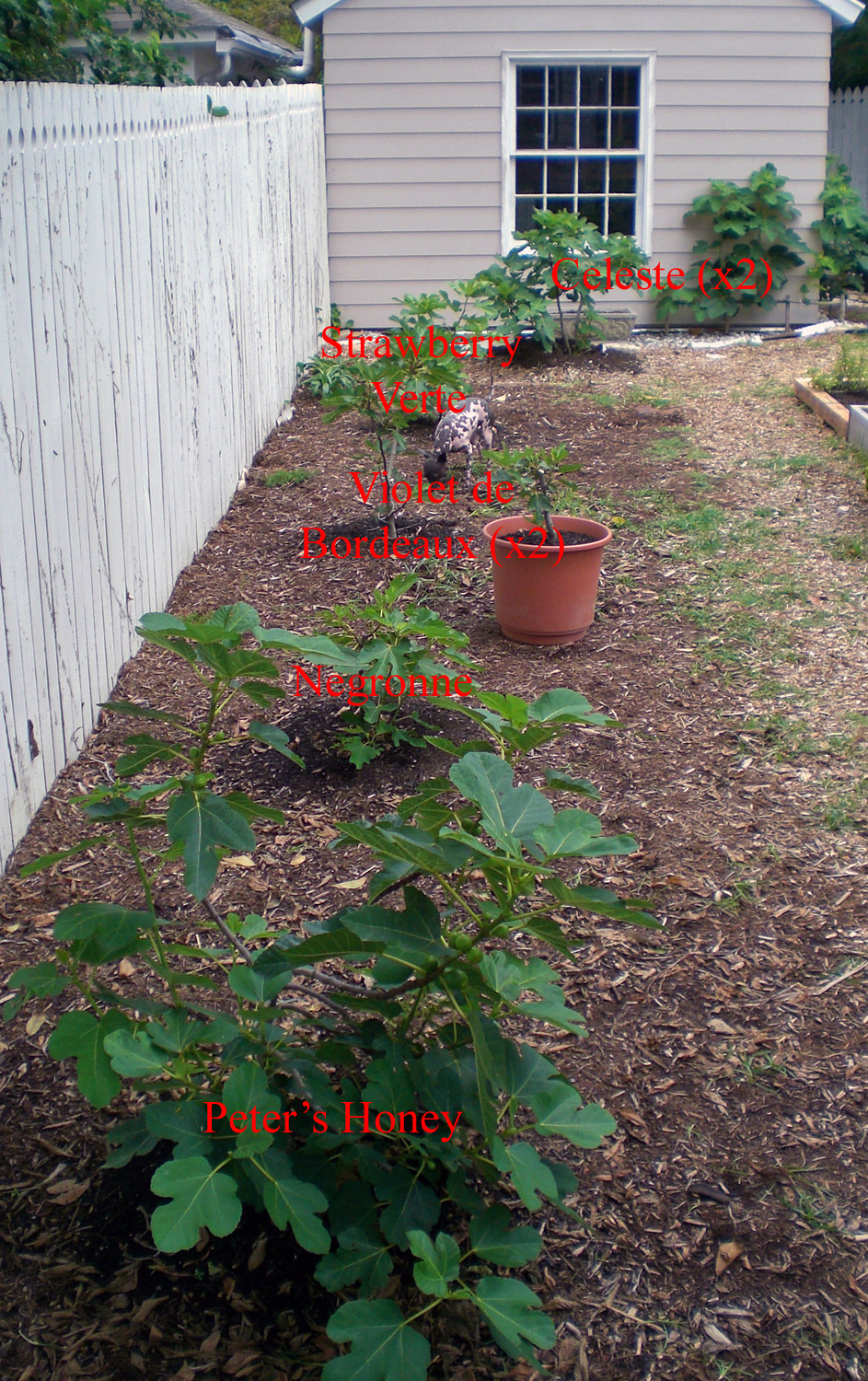
Row of figs down the left wall of the yard.  They are all fairly small, but are adapting well to their permanent location.  I grow a mix of brown, purple, and green figs.   If you look closely, you can spot Scout.  She's the hairless wonder dog.
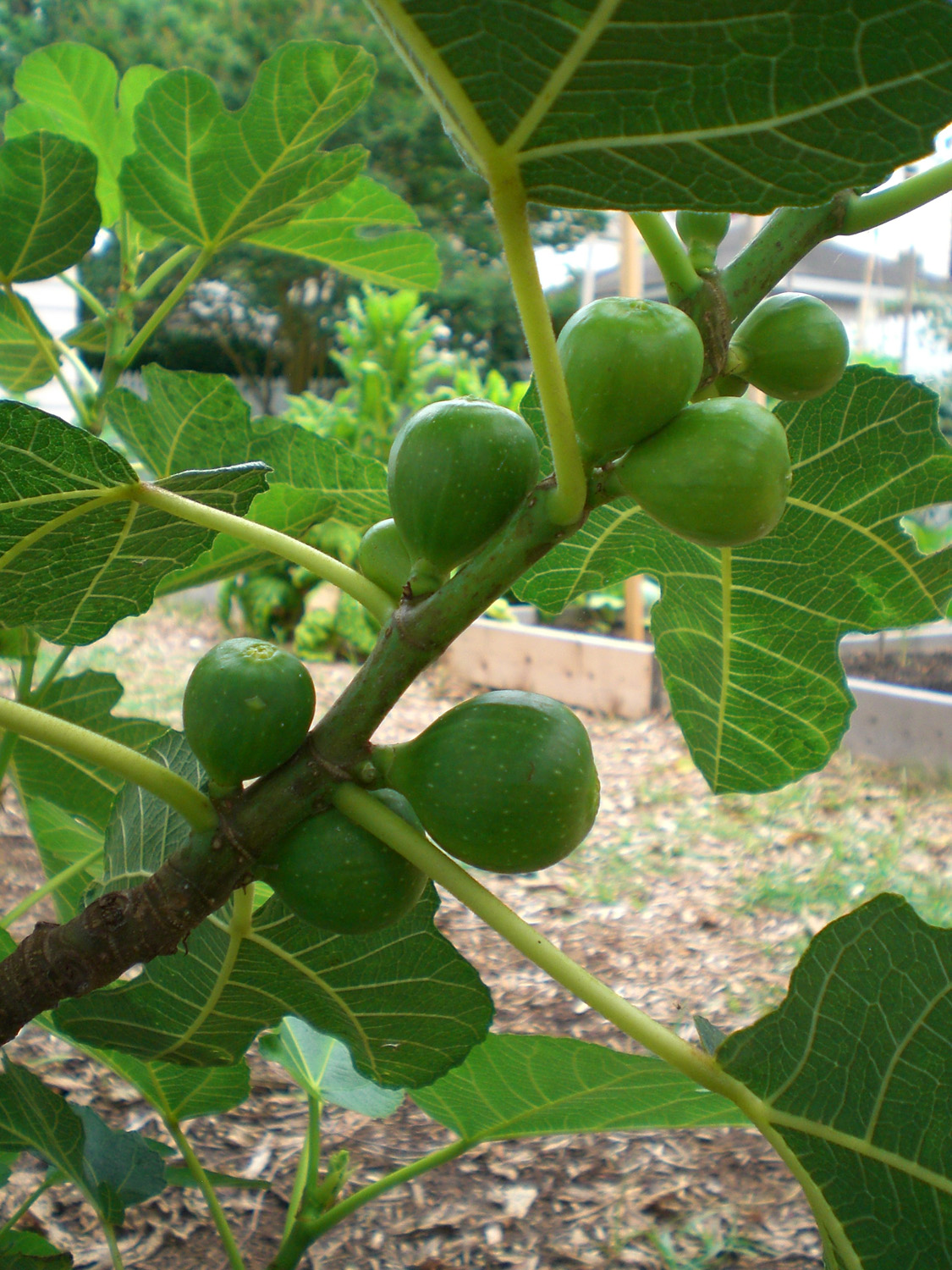
Peter's Honey fig.  In some areas this plant is putting out 2 figs per leaf, and I don't think that's very common. I'm not complaining.
Violet de Bordeaux figs.  I will pick individual ants off the tree to protect these, partly because I'm crazy but mostly because these things are heavenly.
The Red Haven peach tree is getting very large.  I pruned it heavily this winter and again about 3 weeks ago, and it keeps on growing.  I also thinned the fruits a while ago, but it's still hanging about 25 peaches.
Overhead view of the Red Haven peach tree showing the main scaffold limbs.  I'm trying to maintain an open center to allow light in and air to circulate.
I haven't sprayed this tree with a single thing this year and it still looks healthy.  I hope that holds up for the rest of the year.
The Russian Pomegranate also likes its sunny but sheltered location.  It's approximately 7' x 7' and was covered in blooms for 3 weeks.
A tiny pomegranate and a few blooms in the background.
This is a young Haku-Botan pomegranate tree, courtesy of Sybil Mays.  It will eventually produce yellow/gold pomegranates.  Sybil, this is the little plant you dug up from your side yard.  It has recovered and grown ALOT!
It's a cucumber jungle out there.  By now they've established very deep roots and don't show much wilting during the hottest (98 degrees) driest weather this year.
These beasts make a mean cucumber salad.
Ouachita blackberries beginning to ripen.  I'm not sure exactly what happened (or didn't happen), but I think poor or incomplete pollination led to irregularly shaped berries.  Look closely in the picture and you'll see what I'm talking about.
Almost ready.
All the literature says that borage flowers have a cucumber taste.  I disagree.  They taste like borage flowers.  Not really cucumbery, but just a general leafy green pleasant flavor.  I grew these as a companion plant for the tomatoes, but it clearly hasn't helped this season.  
Don't ask me how this partially ripened black cherry tomato tasted.  I wouldn't know.  My dog Diego ate it so you'll have to ask him.  
When most people draw a picture of the devil, they draw a red devil.  The devil is NOT red.  The devil is green.  Check out this mix of Bermuda grass and some other green beasts that are growing well despite Operation Smother.
Bermuda grass a-creepin'.  This is the aforementioned ugly.  I plan on pulling everything I can by hand rather than using some ineffective organic herbicide or crazy poisonous herbicide.  I do not want to mow this back yard ever again.  
I'll post again soon with pictures of the garlic harvest as well as the fig espalier.  How are things growing in your gardens?  If you are fortunate enough to have a bumper crop of heirloom tomatoes later in the summer, I'll likely be begging at your front door. That's a promise.