Showing posts with label Historic Gardens. Show all posts

Monday, September 19, 2011

Heritage Harvest Festival

Last Saturday, the family and I attended the 5th Annual Heritage Harvest Festival at Thomas Jefferson's Monticello in Charlottesville, Virginia.

Image courtesy of the Heritage Harvest Festival. Jefferson's Monticello is on the top left of the image, and his terraced vegetable garden and orchard is located along the right side of the image.
Jefferson was a pioneer of and ultimate advocate for sustainable agriculture, and this made Monticello the perfect location for this great event. In short, the festival included everything from seed sales and heirloom tomato and watermelon tastings to hands-on workshops, presentations, and tours of Jefferson's amazing home, garden, and orchard. I highly recommend this event for anybody interested in all aspects of agriculture and simpler ways of living.

I could write pages and pages about the importance of everything presented at the event, but I figure most people who read this blog likely agree that a handful of seeds, the sweat of your brow, and dirt on your hands can lead to some pretty amazing things. Instead, here is a photo-journey of Thomas Jefferson's garden.

Southwest view of Jefferson's expansive vegetable garden. He located it on a south slope to maximize the sunlight, growing seasons, and air movement down the slope.
Peach and other fruit trees in Jefferson's orchard (center of image). Corn is visible in the left foreground, blooming rosemary on the right, and I'm not sure what's blooming in the center.
A staggered row of sea kale.
A lush bed of sweet potatoes.
Tree onions, also called top-set or walking onions, are very hardy perennial and multiplying top-setting onions. This means that they form new onion bulblets where most onions form flowers. They don't produce very large bulbs, but they are fun to grow and nearly impossible to kill. If you've never tried growing onions, start with these to boost your confidence.
Two rows of onions in between peppers and squash.
French artichokes and a nifty wooden plant label.  Each row of veggies, herbs, and flowers was clearly identified by these labels, which made it much easier to identify specific varieties of plants.
I had never seen sesame before, other than on my bagels, but Jefferson's garden was loaded with it.  Each one of these pods is filled with sesame seeds. I broke open one of the drier, yellow pods with my fingers and seeds spilled onto the ground. I can't think of any other museum or heritage site where you can touch AND break part of the display or exhibit without being arrested!
This West Indian Gherkin (cucumis anguria) caught my eye. This beast doesn't look safe or edible...probably why it remained untouched.
Faded sign on a weathered fence that surrounds Jefferson's old nursery. 
Mulched pathway that cuts through the nursery. In the background you can see the edge of the vineyard.
In the orchard. Jefferson loved peaches and fought the noble fight that we still know today as "growing peaches organically". He had about as much success as we do today... 
Aerial view of Monticello not taken by me. I don't have a helicopter or a proper photo credit.
If you are interested in specific information about Jefferson's agricultural successes and failures at Monticello, you should read Thomas Jefferson's Garden Book. It's a compilation of his horticultural diaries, letters, and sketches. Probably more info than you ever wanted to know about the principal author of the Declaration of Independence and third President of the United States. For example, you'll read in his own words about his love of sweat peas, his favorite veggie. Random, but true.

Did anybody else attend the Heritage Harvest Festival this past weekend? Have you ever been to Monticello? I look forward to hearing from you.

Tuesday, March 15, 2011

Figs, Olives, Grapes, and Other Italian Plants

This may be one of the longest blog posts in internet history, so here goes...

Recently I was lucky enough to take an 8-day trip to Italy.  I visited Rome, Florence, Tuscany, and many other small towns in between. Saw all the major sights, enjoyed unbelievable food, and had a great time.  What surprised me most (aside from the entire experience) was the abundance of fig trees, citrus, olives, grapes, and other beautiful plants scattered all over the country, not just in the vineyards of Tuscany.  Figs were literally growing out of stone and marble walls in Rome.  The following umpteen hundred pictures show the landscape and these plants:

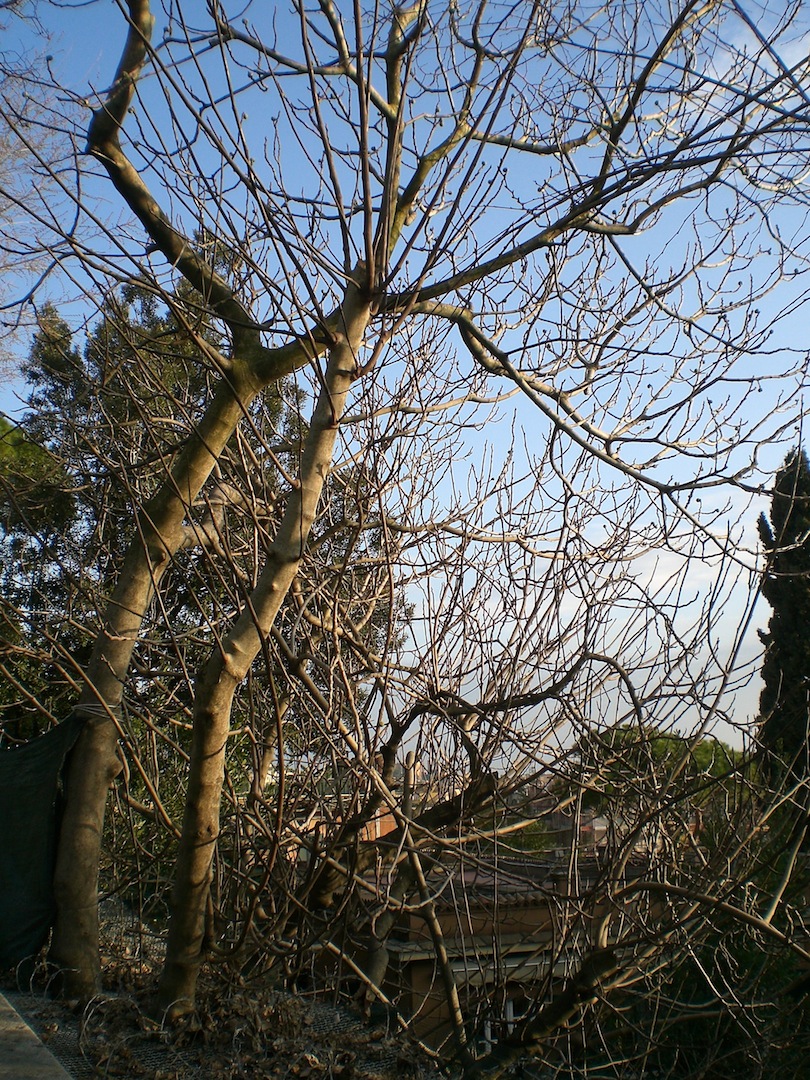
Massive fig tree near the Spanish Steps in Rome.  This tree is about 25-feet tall and begins growing down the hill from where I took this photo.
Well manicured garden in Vatican City with very large potted citrus. Unfortunately you can't access this garden. I snapped this picture from inside the Vatican.
Multi-trunk fig tree growing directly across the street from the Colosseum.  There were a few of these within a couple hundred yards of each other.  
Fig tree (just right of center) in the Roman Forum.
Fig tree in the Roman Forum from a different angle.
Same fig tree in the Forum from a 3rd angle.
Smaller branching fig tree growing from the rocks near the Spanish Steps in Rome.
Orange trees lining the street in central Rome.  I took this pic from my hotel room on the 4th floor.  They grew large and healthy all over the city.  And of course everything within arm's reach was already plucked and devoured.
Vineyard at the 16th century Castello d'Albola in Tuscany.  They produce acclaimed Chianti and Cab Sauv, as well as sublime olive oil.
More neatly pruned and trellised grapes at Castello d'Albola in Tuscany.
Olive trees near Radda in Chianti.  Famers were in the process of pruning the olive trees and burning the cuttings.  You could see and smell small plumes of smoke all over the countryside.
More olive trees.
Even more olive trees.
Approximately 20-foot tall fig trees at Radda in Chianti, Tuscany.
A close-up of the same fig tree in Radda.  I don't know what type of fig it is, but it was easily the most dense and multi-branched fig tree I've ever seen.  Hard to imagine enough light would reach the interior of the tree to ripen figs in the summer.
The fig tree is located right by the road.  You could easily harvest ripe figs from your car in the summer.
I spotted this beautiful blooming tree at a local ceramic maker's shop in Tuscany.  I couldn't figure out what it was until I saw the remnants of the previous year's bounty on the ground beneath the tree.  Almonds!
Almond blossoms. Bees were buzzing about the tree pollinating the flowers.
More almond blossoms clustered together with the ceramic shop in the background.
Grape vines across the street and up the hill from the ceramic shop.  Trellised vines as far as the eye could see, all over the countryside.
I don't know hold old these vines are.  They were not the youngest or oldest vines I saw, but were probably somewhere in the middle.
They prune the vines to maintain growth and productivity.
Close-up of recently pruned grape vine.
The skyline of the small medieval town of San Gimignano in the provence of Siena, Tuscany.  It was a cold and cloudy day.  Note the very large fig tree in the lower left-hand corner of the picture.  
Close-up of the large fig tree in San Gimignano.  Note the old wooden ladder leaning against the trunk of the tree.  I wish I was there in the summer to climb the ladder and sample the fresh figs.
I hope you made it to the end of this post without being bored out of your mind.  Yes, the art, architecture, and culture of Italy are out of this world.  But at the same time, the variety and abundance of plants nestled within this historic setting are no less impressive and equally as beautiful.


Sunday, August 29, 2010

Dusk at Colonial Williamsburg

I made an evening trek to Colonial Williamsburg earlier this week.  I was interested in seeing some of their gardens, particularly the vegetable garden across from Bruton Parish Church and also the gardens behind the Governor's Palace.  Unfortunately the Governor's Palace was closed so I wasn't able to see everything.  I still took a few pics to share, but be warned --  the quality of the pics isn't great.

Deep cold frame bed.  Looks like peas?  It's amazing how early (and late) they can grow veggies in these things. 
Late summer veggies with Bruton Parish Church in the background.
Large pomegranate trees loaded with fruit.  The orchard has 4 or 5 of these and they are about 15 feet tall.
Hanging gourds and muscadine grapes on a massive trellis/arbor.  Sometimes they dry the gourds and turn them into birdhouses.  
Small kitchen garden behind one of the historic buildings.
Fig trees that were cut to the ground about 2 years ago.  Now they are appx. 10 feet tall.
Hidden path flanked by amazing old boxwoods.
Governor's Palace.  Bummer...the best gardens locked behind the gate!  I'll have to return this fall.
Kitchen garden at the Governor's Palace.  Tiered beds prepped for fall planting. I managed to snap a few pics over the brick wall.  
A different view of the Governor's Palace kitchen garden.
You can walk for miles and miles at Colonial Williamsburg and see something new each time.  And if you wear out your shoes in the process make sure you swing by this place on the way out of town.