Showing posts with label Fruit. Show all posts

Wednesday, August 29, 2012

Citrus Brown Rot

I was walking past my potted citrus trees, not really giving them more than a casual glance, when something unusual caught my eye. It was a big nasty brown area on a large but immature lemon.

Ugly looking lemon with a huge brown splotch.
I picked it off the tree and gave it a closer look. It actually had the appearance of a bulls-eye; brown concentric rings spreading from a circular center. I walked inside and fired up the Google while the bulls-eye stared back at me.

After a quick research session, I concluded that this lemon suffered (it's now deceased, I chucked it in the bin) from Citrus Brown Rot. According to the UC Pest Management Guidelines:

"Brown rot is caused by multiple species of Phytophthora when conditions are cool and wet. Brown rot develops mainly on fruit growing near the ground when Phytophthora spores from the soil are splashed onto the tree skirts during rainstorms; infections develop under continued wet conditions. Fruit in the early stage of the disease may go unnoticed at harvest and infect other fruit during storage."

Phytophthora is a tongue twister. It's also sort of like a fungi but also different. I won't get into the biological details. Not because I don't want to bore you, but because I don't understand most of it.

Guess where this lemon was growing? Yup, about four inches off the ground. We received over 10 inches of rain in the past five days and conditions have been generally wet and humid for two months. So basically perfect conditions for this stuff to thrive.

While I was fairly confident I correctly identified the ailment, I was more than disappointed that the person who named said ailment was less than creative. Citrus Brown Rot. Seriously? What about something like Brown Cyclops Syndrome or Ring of Suffering?

Citrus Brown Rot. It's a small price to pay for organic growing.

Sunday, August 5, 2012

Fig Porn

Yeah, that's right, I said it. Fig Porn!

For the true fig lover out there, nothing is hotter than pictures of ripe figs. In full confession, I actually borrowed the expression from a member of the Figs4Fun forum. Here are a few pics of my Violette de Bordeaux and Celeste figs from my garden this morning. Keep your shirt on...

Violette de Bordeaux figs ripening, but not yet ready for harvest.
Violette de Bordeaux and Celeste figs harvested on August 5, 2012.
Fig porn.
Even raunchier fig porn.

Fig porn on a Sunday?! I'm gonna burn for this one.

Saturday, August 4, 2012

Figs Are Ripening

This is what a ripe Celeste fig looks like.

Ripe Celeste fig hanging from a branch, waiting to be picked and eaten.
Notice how the fig has drooped, transitioned in color from green to dark brown, and the skin is visibly cracked. This fig also felt very heavy for its size. These are all good indicators that a fig is ripe.

My Celeste figs have been ripening since mid-July, and now my Violette de Bordeaux figs are starting to swell in size, change color, and droop a little bit. I will definitely be posting pictures of those as well for comparison.

Hope everybody else is enjoying mid-summer fruits from their own gardens.

Wednesday, June 27, 2012

Espalier Fig IV

My most recent blog post about figs quickly generated lots of good comments. But one comment in particular stood out from the crowd. Check it:

"When I saw the headline I was SOOO excited that finally I was going to see what happened to the espalier you hacked off. What a tease... Please don't make us wait too much longer... Helen"

Well Helen, this post is for you.

On March 15, I did what some would consider a barbaric pruning job of my espalier fig. I sawed off all the vertical limbs just above the very bottom growth nodes. It was a job that even George Washington of great cherry tree chopping prowess would have to acknowledge with a tip of his hat.

Heavily pruned espalier fig on March 15, 2012

I'll admit at first I was a bit worried about the recovery of this fig tree. But at the same time, I was aware that fig trees are nearly impossible to kill. So basically I sawed, then sweated, then decided to sit back and let Mother Nature take it from there.

What does the espalier fig look like approximately 100 days after pruning? You wouldn't even know that I laid my hands on it.

Espalier fig on June 27, 2012. Most of the vertical limbs are nearly 7 feet tall. My dog Scout is in the picture to show you my fierce and formidable fig defender. I trained her so well to protect my fig trees from any number of different predators that she barely lets me near them without a promise from me to share the spoils.

The majority of the vertical limbs are now 7 feet tall, covered in lush foliage, and loaded with unripe figs. I'm also attempting to extend the right-most horizontal arm of the espalier. Last year I accidentally broke it off and it didn't re-grow. This spring, it shot out another arm and I quickly started to train it horizontally.

Slowly extending the length of the right-most vertical limb of my espalier fig near the shed door. I hope to train two vertical growths from this new extension over the next year or two.

Because I'm a bit clumsy, I also accidentally broke off two vertical growths early this spring. I'm still kicking myself about it because one never grew back and the other caused some lasting damage to the tree.

A sad reminder of what dragging a heavy garden hose can do to the tender new growth of a fig tree. Snapped it right off. Now it's just an ugly stump.
This growth was also damaged by a garden hose that I was trying to un-kink. The hose swung up in the air and snapped off the original growth that started in March. This skinny shoot that is now almost horizontal is a second growth. I'm waiting for it to harden off a bit before I train it vertically, otherwise it may break off again.

As a result of breaking off the growth in this second area, I exposed the fig tree's right horizontal limb to excessive direct sunlight due to lack of protective foliage. Believe it or not, a fig tree can get a pretty nasty sunburn and this is definitely the case with my tree. Have a look at the sun-damaged bark.

Sun damage on the right horizontal growth of my espalier fig. Hopefully it will recover. Some literature suggests that you can whitewash the exposed trunks of fig and other fruit trees to protect them from sun damage. Cue the SPF jokes...

Lastly, here are two pictures showing the new vertical growths. The first pic shows the base of a growth, and the second pic is take from above to provide a different perspective.

This year's growth directly above a pruned area. I stripped off two leaves to expose this area for the photo.
This is the same vertical growth depicted in the photo above. Note the figs growing above nearly every leaf. I can't wait for these babies to ripen, and neither can Scout (and every other bird, squirrel, ant, and creature in the yard).

So there you have it, Helen! A post about my espalier fig just for you. Hope you enjoyed it.

Thursday, June 14, 2012

They're Figgin' Huge!!

When healthy and planted in a good location, fig trees can grow unbelievably quickly and become very productive. Here is a photo of my fig trees 15 months ago after I transferred them from pots into the ground.

Fig trees down the left wall of .09 Acres in late March, 2011.
What do they look like today on June 14, 2012? Check it.

Fig trees down the left wall of .09 Acres in mid June, 2012.
Yup, pretty darn beastly if I do say so myself. Let's take a look at them in more detail.

4 year old Negronne fig. This plant is almost 6 feet tall and equally as wide. I pruned it heavily in early March to encourage multiple branches to grow from the pruned areas. It is beginning to form a nice multi-stem shrub.
5 year old Violette de Bordeaux fig. This plant is almost 6 feet tall and nearly 8 feet wide. I also pruned it heavily in early March to maintain a mult-stem shrub. It is important for me to prune my figs to a manageable size in such a small yard.
Negronne and Violette de Bordeaux figs. Looking good.
Very young LSU Purple fig. This plant is just over 1 year old and has a long way to go. I actually dug out another fig tree (thought it was a Strawberry Verte fig but it turned out to be a Magnolia fig...they split heavily in high humidity) previously planted in this location and replaced it with the LSU Purple.
6 year old Celeste fig from Paradise Nursery. This is the first fig tree I ever purchased, and now it has really settled into a permanent home. It is 7 feet tall and nearly 9 feet wide. This is always the first fig variety to ripen in my yard, usually in early July. Waiting...
Some of you might be wondering if all the heavy pruning I do in early spring to maintain smaller plants significantly reduces the amount of figs that I harvest. The answer to that question is quite simple. No. Here are two pictures of figs on my Violette de Bordeux fig tree, which I have pruned heavily for 3 years.

Unbelievably prolific variety of fig. But it takes great patience to watch these little VdB figs grow and ripen.
More young VdB figs. I'm optimistic that this will be an epic year for figs.
I plan on taking pictures of these figs again in the winter after they have dropped all their leaves to show the overall form of each multi-stem shrub. I also plan on taking pics during the pruning process next March to better illustrate how I prune my figs. And stay tuned for an update on my fig espalier later this summer.

Happy growing.

Monday, May 14, 2012

Simple Equation for Happy Citrus

Here's a simple equation for happy citrus trees:

Bright sunlight + warm temperatures + ample rain + organic citrus fertilizer = very happy potted lemon and lime trees.

It really is as simple as that. Here are a few pics of my productive lemon tree:

Young lemons developing on the tip of a branch. These lemons grew from flowers that bloomed in early March inside my house. I actually hand-polinated them with the tip of my finger since I don't have a beehive in my house!
Second flush of citrus blossoms in early May. Note the purple/pink buds that are not yet open, the newly opened bloom on the left, the recently pollinated bloom in the center, and the newly developing lemon on the top right portion of the picture.
This year's growth has me very optimistic for a delicious crop of juicy limes and lemons in late fall/early winter, particularly after last year's mediocre citrus season. Actually, it was more my fault than anything else. I placed both potted trees on top of my outdoor table. They blew off during a thunderstorm and suffered some pretty bad damage. The top half of my lime tree snapped off completely! Bad news, but lesson learned. Fingers crossed for 2012.

Sunday, March 18, 2012

March Madness

The madness has set in. Not college basketball madness. I'm talking spring garden madness. Average temps have been consistently warm for the past few weeks, and I think the plants in the yard believe it is April. Enjoy the following picture tour of March Madness at .09 Acres:

Still harvesting Chantenay Red Core carrots from the garden.
This 18.5 oz carrot dwarfed the 14.1 oz carrot I harvested 2 months ago. I don't have the largest hands, but this octopus-like carrot is ridiculous. This carrot is grown from seed I purchased from Southern Exposure Seed Exchange (SESE).
Japanese maple waking up from winter slumber. This tree was a seedling from parent's old house in Virginia Beach. I also gave a second seedling (now about 8 feet tall) to my friends Elsa and Matt in Norfolk.
Gardeners know that mint is extremely invasive. Here is a half-barrel of mint scrambling for more real estate. 
Rosemary. Yum.
Rosemary blooms. Yum?
Cold hardy mache appears as if it will be going to seed very shortly. It doesn't like hot weather.
Arugula in full bloom. I save seed from this plant every year. It's very easy. Just wait for the seed pods to dry on the plant, then cut the flower stalk and shake the dry pods in a brown bag. Voila! Seeds!!
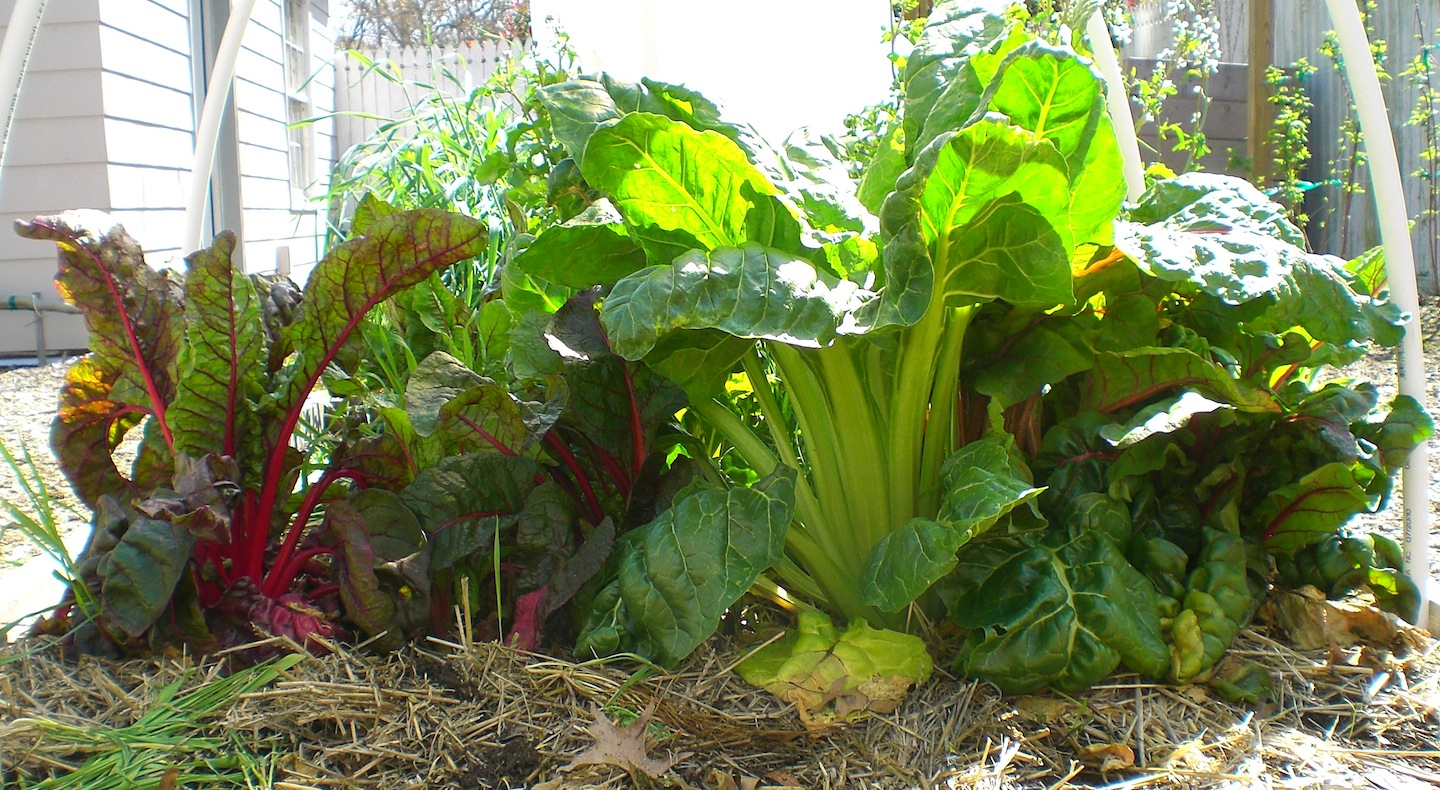
A 4-foot row of various Swiss Chard. This stuff is versatile in the kitchen and grows in all weather conditions.
Ruby Red Chard from SESE.
Kale. I grew my kale exposed all winter. No plastic, floating row cover, or hoop house. Resilient for sure. Try kale soup with chorizo. You won't be disappointed.
Red bunching onion grown from SESE seed sown last fall.
This Calabrese broccoli is destined for pasta with olive oil and garlic.
Winter Density has been the top lettuce producer in my garden for the past two years. The only problem I have is dealing with slugs and aphids that crawl inside the wrinkly leaves. Nothing a little water won't solve.
A row of trellised Fall Gold, Kiwi Gold, and Heritage Red raspberries. These are a must-grow in the Mid-Atlantic and Tidewater area.
Thornless Ouachita blackberries busting loose.
Potted lemon tree preparing to bloom. Looking forward to a better citrus harvest in 2012-13. This past year was disappointing. I only harvested a handful of lemons and limes.
Russian Red Pomegranate (8 feet tall) from Edible Landscaping in Afton, VA.
Russian Red Pomegranate leaves reaching for the sun.
Celeste fig tree (appx. 6 years old) from the now-closed Paradise Nursery. I've pruned this every year in order to encourage a low, wide shrub-like growth. More branches = more figs.
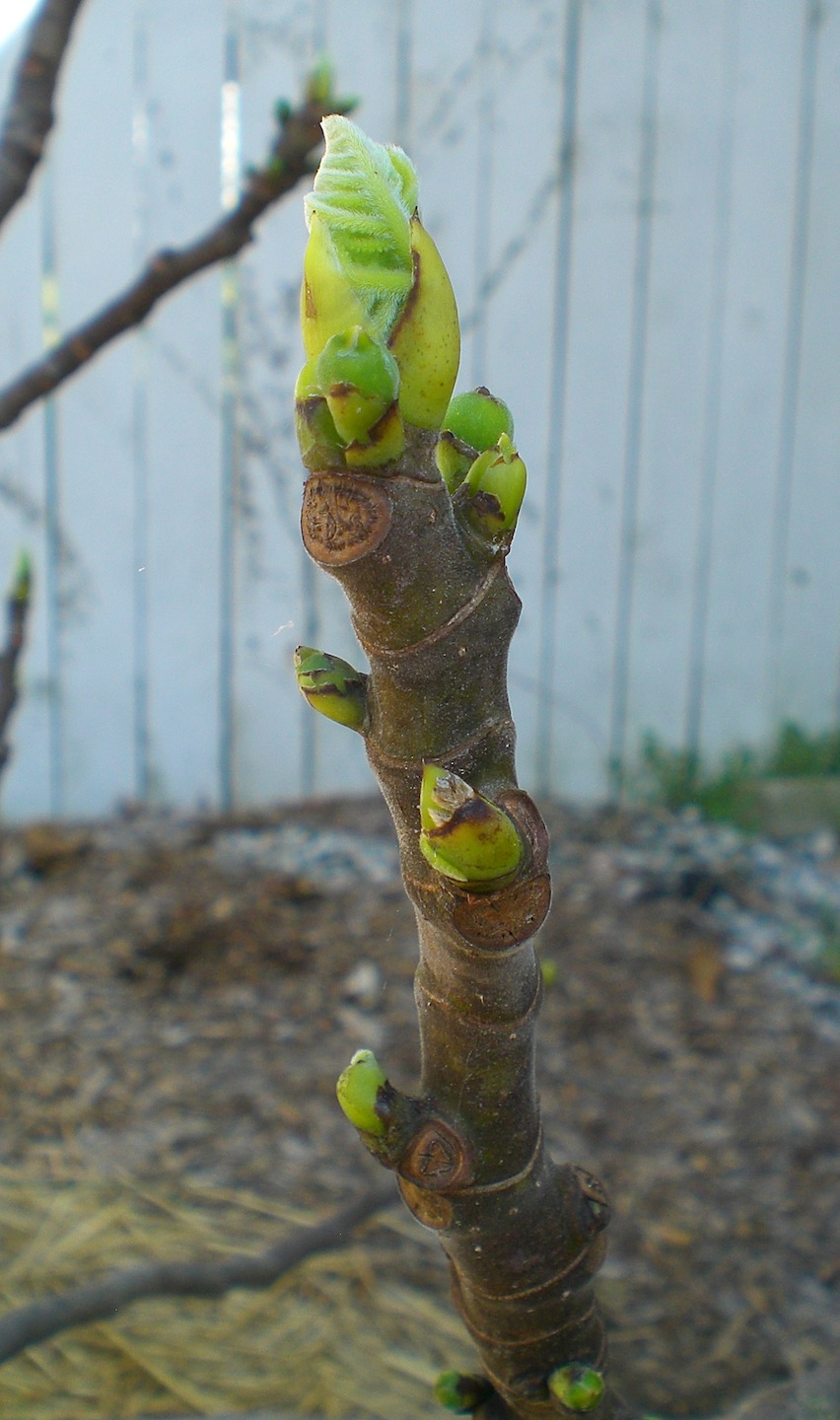
The tip of a Celeste fig tree branch. Notice the combination of new leaves and tiny figs. Some varieties of figs produce 2 harvests per year. The early figs are called brebas.
Another view of the Celeste fig tree. Note the multiple growths on each branch. If I didn't prune, I would have a tall, lanky tree rather than a dense shrub.
My fig espalier at the corner of my garden shed. 3 days ago I pruned off all of last year's vertical growth near the two main horizontal arms. I left a single vertical node from last year's growth in order to allow the new branches to grow from those same locations this year. I will repeat this process year after year. Grow, harvest, prune. Grow, harvest, prune.
Detailed photo of a vertical node extending from a horizontal branch of the Celeste fig espalier. New growth will appear on the rough area of the top portion of the vertical node. New growth will also likely appear elsewhere, but I will prune or rub off the new growth before it negatively impacts the desire appearance of the overall espalier. 
I hope you enjoyed your tour of March Madness at .09 Acres. My apologies for not posting here more consistently during the past few weeks. Work has been eating me alive, and it's great to be back outside again. Wishing you good growing and great harvests in your gardens!