Showing posts with label Broccoli. Show all posts

Sunday, March 18, 2012

March Madness

The madness has set in. Not college basketball madness. I'm talking spring garden madness. Average temps have been consistently warm for the past few weeks, and I think the plants in the yard believe it is April. Enjoy the following picture tour of March Madness at .09 Acres:

Still harvesting Chantenay Red Core carrots from the garden.
This 18.5 oz carrot dwarfed the 14.1 oz carrot I harvested 2 months ago. I don't have the largest hands, but this octopus-like carrot is ridiculous. This carrot is grown from seed I purchased from Southern Exposure Seed Exchange (SESE).
Japanese maple waking up from winter slumber. This tree was a seedling from parent's old house in Virginia Beach. I also gave a second seedling (now about 8 feet tall) to my friends Elsa and Matt in Norfolk.
Gardeners know that mint is extremely invasive. Here is a half-barrel of mint scrambling for more real estate. 
Rosemary. Yum.
Rosemary blooms. Yum?
Cold hardy mache appears as if it will be going to seed very shortly. It doesn't like hot weather.
Arugula in full bloom. I save seed from this plant every year. It's very easy. Just wait for the seed pods to dry on the plant, then cut the flower stalk and shake the dry pods in a brown bag. Voila! Seeds!!
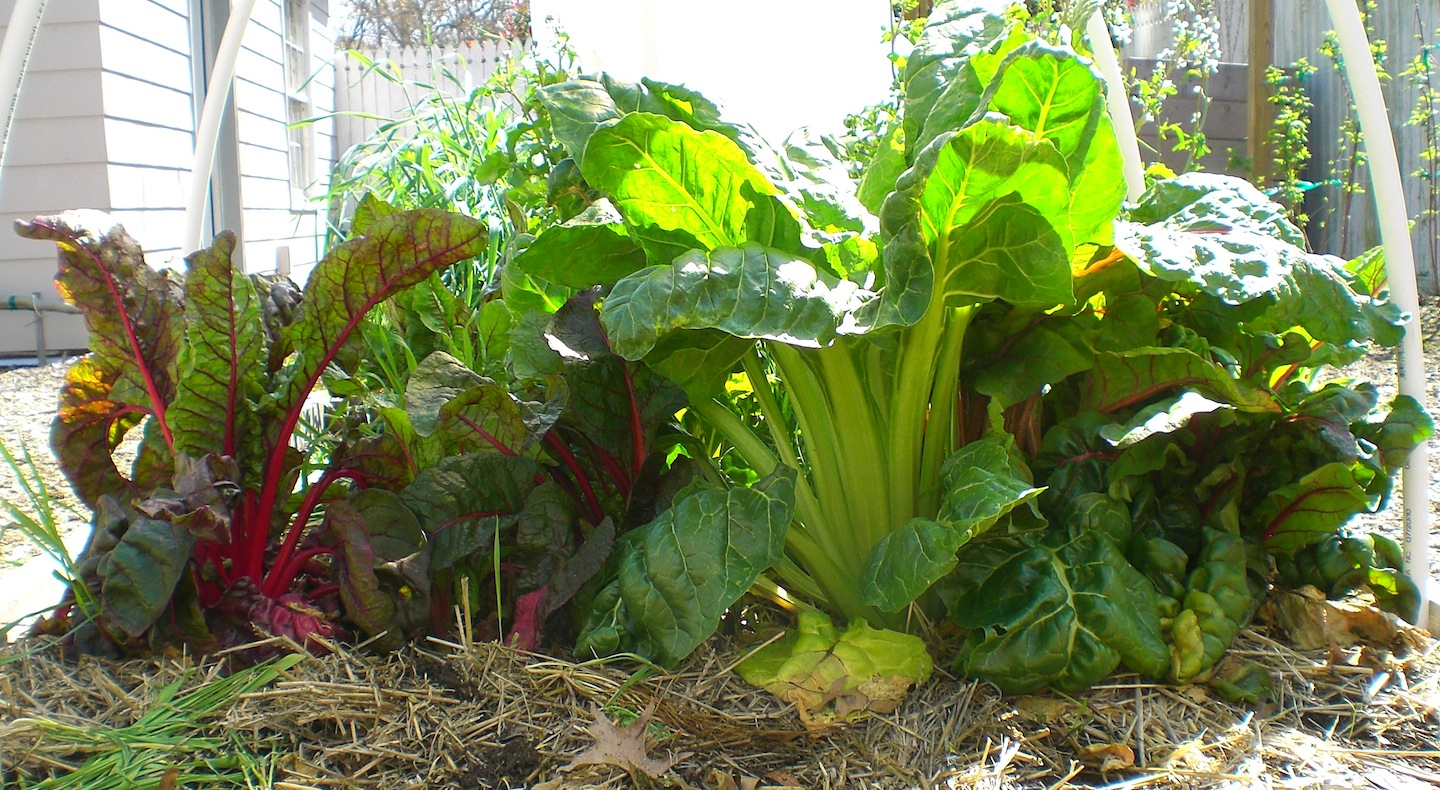
A 4-foot row of various Swiss Chard. This stuff is versatile in the kitchen and grows in all weather conditions.
Ruby Red Chard from SESE.
Kale. I grew my kale exposed all winter. No plastic, floating row cover, or hoop house. Resilient for sure. Try kale soup with chorizo. You won't be disappointed.
Red bunching onion grown from SESE seed sown last fall.
This Calabrese broccoli is destined for pasta with olive oil and garlic.
Winter Density has been the top lettuce producer in my garden for the past two years. The only problem I have is dealing with slugs and aphids that crawl inside the wrinkly leaves. Nothing a little water won't solve.
A row of trellised Fall Gold, Kiwi Gold, and Heritage Red raspberries. These are a must-grow in the Mid-Atlantic and Tidewater area.
Thornless Ouachita blackberries busting loose.
Potted lemon tree preparing to bloom. Looking forward to a better citrus harvest in 2012-13. This past year was disappointing. I only harvested a handful of lemons and limes.
Russian Red Pomegranate (8 feet tall) from Edible Landscaping in Afton, VA.
Russian Red Pomegranate leaves reaching for the sun.
Celeste fig tree (appx. 6 years old) from the now-closed Paradise Nursery. I've pruned this every year in order to encourage a low, wide shrub-like growth. More branches = more figs.
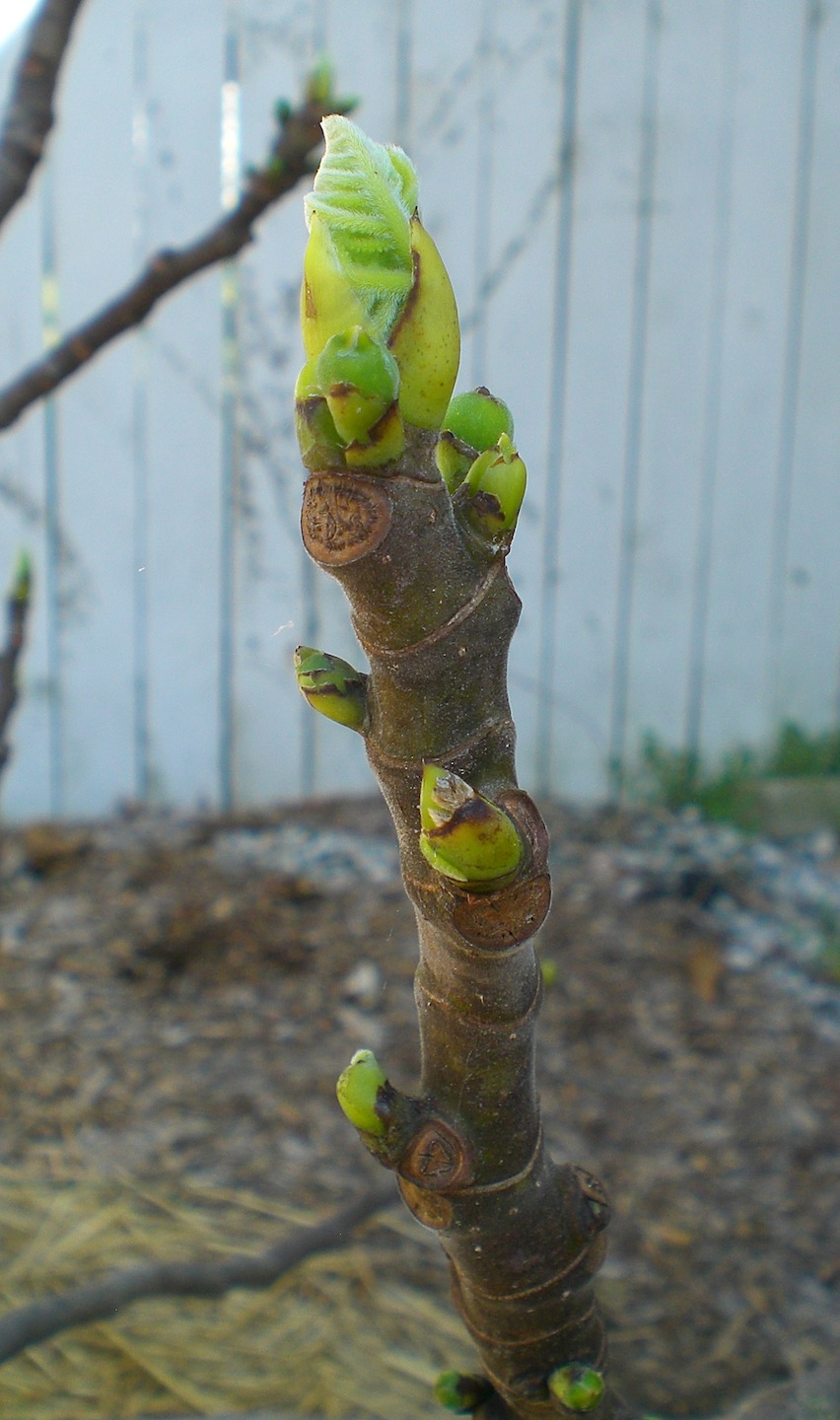
The tip of a Celeste fig tree branch. Notice the combination of new leaves and tiny figs. Some varieties of figs produce 2 harvests per year. The early figs are called brebas.
Another view of the Celeste fig tree. Note the multiple growths on each branch. If I didn't prune, I would have a tall, lanky tree rather than a dense shrub.
My fig espalier at the corner of my garden shed. 3 days ago I pruned off all of last year's vertical growth near the two main horizontal arms. I left a single vertical node from last year's growth in order to allow the new branches to grow from those same locations this year. I will repeat this process year after year. Grow, harvest, prune. Grow, harvest, prune.
Detailed photo of a vertical node extending from a horizontal branch of the Celeste fig espalier. New growth will appear on the rough area of the top portion of the vertical node. New growth will also likely appear elsewhere, but I will prune or rub off the new growth before it negatively impacts the desire appearance of the overall espalier. 
I hope you enjoyed your tour of March Madness at .09 Acres. My apologies for not posting here more consistently during the past few weeks. Work has been eating me alive, and it's great to be back outside again. Wishing you good growing and great harvests in your gardens!

Sunday, February 19, 2012

Broccoli Double Vision

I've been eating lots of hefty carrots recently. This should be evident by my last blog post. Carrots contain Vitamin A, which is an essential nutrient for good vision. Despite my prodigious intake of these health-supporting wonders, I discovered that something was wrong with my eyesight this afternoon.

After lunch, I walked out into the rain to plant some radishes in my garden. I was a few feet from my potted Calabrese broccoli when I started seeing double. I could've sworn I harvested my broccoli last month, but sure enough...side shoots of broccoli had sprouted up everywhere! Double broccoli!!

Side shoots of Calabrese broccoli (left and bottom). I harvested the central head of broccoli on January 19. Notice the off-white area near the center of the picture where I cut the central head with a small knife. Exactly one month later I harvested the side shoots.
Calabrese broccoli is no one trick pony. It grows not once, but twice. Exactly one month had passed from the time of my initial harvest to today's second harvest. Here's a close-up view of some side shoots.

Secondary shoots of Calabrese broccoli growing from the side of a potted plant.

Because of my relatively care-free harvest and positive experience with broccoli this year, I am planning on growing multiple varieties next fall. In addition to Calabrese, I will be sowing seeds of Super Rapini broccoli raab and Romanesco broccoli.

Broccoli varieties for future planting at .09 Acres.

I definitely recommend home-grown broccoli for every gardener, beginner or advanced. You will be pleasantly surprised with your harvest if the plant is grown in compost-rich soil and kept moist. Here's a list of the pros and cons of growing broccoli:

PROS:
  • large central heads of sweet, tender broccoli
  • secondary harvest of side shoots 3-4 weeks after main harvest
  • unbeatable flavor compared to insipid store-bought broccoli
  • extremely tolerant of hard frosts and variable weather
  • can be grown in large pots
  • beautiful blue/green foliage

CONS:

  • young plants are prone to attack by caterpillars
  • needs steady supply of water as a seedling
  • large size when mature (appx. 36" in diameter in my garden) 
  • long time from seed to harvest 

Thursday, January 19, 2012

Back in the Garden Again

My apologies!  It's been well over a month since my last post. The holidays and an INTENSE workload really put a dent in my gardening and blogging time. In the past 6 weeks I've done little in the yard and nothing with the blog.

Considering my neglect of the garden during this period of time, I expected Mother Nature to force me to tighten my belt a notch or two by wreaking total havoc on my tasty veggies and herbs. I imagined hard frosts, harsh winds, and cold dry air conspiring against me. I pictured languishing lettuce, crusty carrots, and beat up beets.

What did I find? Beautiful broccoli.

Calabrese broccoli head approximately 8" in diameter. This plant was grown in a glazed ceramic pot.
Don't think broccoli is beautiful? How about now?

Calabrese broccoli head.
This head of broccoli looks almost like a coral reef you'd expect to see off the Florida Keys rather than in a backyard garden in Newport News, Virginia. This plant was grown from seed in a large glazed ceramic pot. I mulched it with a thick layer of wheat straw after it germinated and haven't fussed over it since then. Yes, I hand-picked a few caterpillars but did little else. It is also growing smaller side shoots that I will only cut after I harvest the main head.

What else did I find that I didn't deserve? A cool cover crop.

Diego standing guard over a 4' x 8' bed of winter rye and hairy vetch cover crop.
I purchased Wren's Abruzzi Winter Rye and Hairy Vetch cover crop seeds last September from Southern Exposure Seed Exchange at the Heritage Harvest Festival at Monticello. I mixed and planted them in a 4' x 8' bed previously occupied by my Inchelium Red garlic. The seeds germinated easily and very quickly filled the bed. It's a vibrant addition to the otherwise muted colors of the winter landscape. I plan to cut and till the cover crop into the bed in early spring before planting tomatoes in late spring.

The cover crop is also important for another reason I did not anticipate. Dogs are natural foragers, and my two dogs often ate grass in my previous yard to aid in digestion. By successfully smothering my grass, I unintentionally eliminated one of their favorite diet supplements. Last summer, I often found my dogs sampling different weeds and other greens because they were looking for a suitable substitute for their favorite but now missing forage. As soon as the cover crop germinated and grew, Diego would regularly run over to the bed and dine on selected shoots of Winter Rye. He still does, seems to love the stuff! So in a way, it's a happy system. Soil feeds cover crop; cover crop feeds soil, dog, and future plants; plants feed human; human feeds cover crop to the soil; repeat. My only concern is that Diego doesn't get comfortable dining on whatever he choses from the raised beds. That could be a problem.

Maybe I'll construct a bone-shaped raised bed for dog edibles...then again, maybe not.

The broccoli and cover crops are just two of the many reasons why Diego and I are beginning to appreciate winter gardening more than summer gardening. There is little to do after planting and germination other than to harvest the rewards of Mother Nature. No toiling, no tilling, no sweating.

Many other veggies are doing very well despite my neglect, but I'll save them for another post. Hope all is well in your gardens.

Monday, December 12, 2011

A Jekyll and Hyde December

.09 Acres is having an identity crisis this December, and I fear that Dr. Henry Jekyll and Mr. Edward Hyde are living in my garden shed.

Dr. Jekyll and Mr. Hyde in the well-appointed garden shed at .09 Acres. Image courtesy of Wikipedia.

Let's start with Dr. Jekyll, shall we?! The vegetables at .09 Acres are much like Jekyll. They are mature and respectable. The lettuces and chard are good looking, tasty, and protected by the mini hoop house. The carrots, beets, and broccoli are doing just fine while prominently exposed to the elements. At this point in the year, they are all content in their beds until harvest. I'm not one to boast, but my greens look like they belong in a gardening catalog. If you were to walk by the lettuce bed, you might even respectfully tip your cap as if you were passing Dr. Jekyll on the street.

On the flip-side, my fruit trees, shrubs, and brambles are behaving in an irrational and unpredictable Hyde-like fashion. The inconsistent weather, much like Mr. Hyde's strange potions, is triggering all kinds of strange reactions from the plants. Raspberries continue to mature on a  semi-regular basis almost like it's early fall. The Celeste fig tree and espalier dropped all their leaves weeks ago. In contrast, my Violette de Bordeaux and Negronne fig trees are still covered in leaves and figs. It is quite grotesque to see them growing side-by-side. My Red Russian pomegranate is the only "normal" tree in the yard, having gone dormant in November. But who knows...it may be inwardly lusting for some sinister transformation.

A little bit of Jekyll, but certainly a lot more of Hyde at .09 Acres.

If .09 Acres is Dr. Jekyll (and Mr. Hyde), I guess that makes me Jekyll's loyal servant Poole. This December I've been out in the yard early in the morning and late in the evening to cover the greens in plastic. I've also changed quite a few things in the yard to keep Jekyll happy and productive. I dug up and potted my in-ground blueberry bushes and replaced them with a young Angel Red pomegranate tree (visible on right side of above picture in middle of straw mulch). I also transplanted a Peter's Honey fig and an unknown fig from my yard to my aunt and uncle's property and replaced them with Strawberry Verte and Hardy Chicago figs (visible on left side of above picture in middle of straw mulch).

Hopefully this will decrease the likelihood that Mr. Hyde shows up again at .09 Acres, but I may be losing my mind in the process...