Showing posts with label Orchards. Show all posts

Tuesday, December 6, 2011

Same Day, Different Leaves

Check this out. Here is a picture taken last weekend of my Celeste fig. All leaves dropped, looking dormant and ready for winter.

Celeste fig. I'm trying to keep it pruned as a multi-stem shrub.
And here's a pic of my Violette de Bordeaux (VdB) fig taken on the same day. Keep in mind that this fig is planted only about 15 feet away from my Celeste fig with the same general southerly exposure.

Violette de Bordeaux fig fully leafed out in December.
This VdB fig has all of its leaves with only minor brown/dry damage from a recent frost, and it is also still loaded with figs. The difference between this tree and the Celeste is really quite amazing.

I guess variety is the spice of life, even in the world of figs!

Tuesday, November 15, 2011

Pomegranates: What a Difference a Year Makes

Last year around this time, I was really excited when I harvested 3 pomegranates from my Russian Red pomegranate tree. That tiny first harvest may not seem like a big deal to you, but it was a big deal to me. I felt like my little tree that I carefully grew and nurtured for a few years just graduated from grade school. It experienced some growing pains, but learned the basic skills it needed to survive.

What a difference a year makes! Last Sunday, I was beaming with pride as I harvested 24 pomegranates from the same tree. This was no small-time graduation...this was the equivalent of graduating from Harvard with honors.

Basket loaded with freshly harvested Russian Red pomegranates.
The pomegranates are not as large as varieties you typically find in a grocery store, but they do the trick.

Fist full o' pomegranates.
The pomegranate arils (seed casings) have a dark, rich color and the perfect balance of sweetness and tartness.

Pomegranate arils.
And with a little sweat and patience balanced with a dash of swearing, these pomegranates made great juice. Much better than commercial juice, no fooling. Check it out.

Freshly made pomegranate juice. No sugar required, 100% natural.
Beware, many pomegranates were harmed in the making of this juice. My entire harvest of pomegranates only made about 2 quarts of juice.

But that only made me wonder what next year's harvest will produce...

Tuesday, October 25, 2011

Peter's Honey Fig: Great Hope or Great Hype?

I'm very specific about my figs. I tend to like dark figs better than green figs. I like sweet figs, but not sickeningly sweet figs. They also must have a "figgy" flavor. I want my figs to taste like figs, not like other things such as honey or jam.

After downing hundreds of black, purple, and brown figs over the years, I decided it was time to explore green and yellow figs. Peter's Honey was one of the first varieties that caught my attention online. Website descriptions included the words "productive", "long growing season", "amber", and "sweet". People growing the fig in different regions raved about its growth habit and flavor. I had to try it for myself to see if it matched the hype.

I purchased a 1-gallon potted plant three years ago and planted in the ground. It grew and grew and grew, and this year it was LOADED with well over 100 figs. I can state with 100% confidence that this variety lives up to its billing as a "productive" fig. Prolific is probably a more accurate term.

Peter's Honey fig tree branch loaded with fruit. Every new branch on the tree was covered with 15+ figs. 
I can also attest that this variety is not well suited for growers in cooler regions of the country. It took loads of heat and sun to ripen these figs. Again, Peter's Honey matched its online persona of a plant that needs a "long growing season". Southeastern Virginia is warm enough for a sufficient period of time to ripen almost any fig. So far Peter's Honey was 2-for-2 in my un-scientific trial.

What about the "amber" color? Look at the beautiful interior of this fig. It's definitely a rich amber color. Check!

Sweet amber interior of a Peter's Honey fig.
Now for the most important attribute in my book...flavor. How did it taste? Sweet as honey! Peter's Honey fig definitely lived up to its reputation and all the hype.

So we can all agree that this variety of fig is a smashing success for everybody's garden, right?! Not so fast. Yes, it's productive and colorful and sweet. But that's part of the problem. I now have a tree loaded with dozens of figs that taste like, well, sweet. That's it. No classic rich fig flavor at all. Just a ball of sugar. Definitely not my hope.

Some of you may be licking your chops at the thought of an abundance of sweet figs and are ready to order a Peter's Honey tree for your yard. If so, go for it! I'm the last guy to discourage somebody from growing a fig tree. On the other hand, I do have a few words of caution about Peter's Honey compared to the other fig varieties (Violette de Bordeaux, Negronne, Celeste, etc.) I grow in my yard:

1.  It has a sugary sweet taste but no fig flavor.
2.  It is the last fig to ripen.
3.  For the past 2 summers, each fruit has had unpleasingly thick skins.
4.  When near-ripe, the figs suffer badly in high humidity and rain, and they get moldy fairly easily.
5.  It was the variety most prone to attack by ants (but not by birds) this summer.

Remember that these gripes are based solely upon my experiences in my yard in southeastern Virginia. The flavor and growth habits of figs can change drastically from region to region.  Fig preferences also vary greatly from grower to grower. Many fig junkies seem quite pleased with their Peter's Honey figs, but not me. As with most things in the garden and life, I guess it all comes down to personal preference.

Sunday, October 9, 2011

Ripe Fig

I received a few e-mails recently about ripe figs. Both e-mails concluded by saying basically the same thing: you always post about your fig trees, but you never show photos of ripe, sliced figs.

At first I was skeptical. I do always post about figs, and surely there had to be at least ONE picture of a ripe fig bursting with sugary goodness. So I went through each post. What were my findings? To date, I've posted about figs on 15 separate occasions (this one makes 16). Guess how many shots of harvested and sliced figs...ZERO! Fair enough, criticism and message received!

It took me no time at all to realize why this has happened. Much like fresh yellow/gold raspberries, perfectly ripe figs almost never reach the inside of my house let alone remain there long enough for a picture or two. They are too tasty and get devoured in an instant.

To remedy this problem, I marched out into my backyard about an hour ago with my trusty camera at my side. I looked for ripe figs amongst the thick foliage and quickly zeroed in on this cluster of dark figs.

Ripe and near ripe figs.
I took a second photo, but from a slightly different angle.


I decided to harvest the middle fig, and left the bottom and top figs in place. They still need a few more days to ripen. I then marched inside, fig and camera in hand. I rinsed off the fig at the sink, then placed it on a plate and took another photo.

Ripe and ready for a snack.
Next came the knife, and I made two quick cuts. Now without further ado, I present to you a ripe fig that I just harvested from one of my trees.

Ripe dark fig a few seconds before its demise.
Click on the photo for a close-up of the sugary sweet pulp that fills the interior of the fig. Amazing. Yes, it's only one fig. Yes, it's only two bites. But they are two bites that are worth a year's wait.

Thursday, September 29, 2011

Espalier Fig III

It's time for another update on my espalier fig. I planted a young Celeste fig in the ground at the corner of my garden shed about 18 months ago. Since that time, I've continuously trained it and pruned it. My previous two posts (Feb. 8, 2011 and June 10, 2011) show the process from its early stages, both in active growth and dormancy.

The tree has flourished this year and is now almost at or above the roofline of the shed.

Fig espalier.
I am continuing to train vertical shoots at 9" spacing. This is fairly easy to do when the growth is new, but you don't want to try it with very new green growth. I found out the hard way when I accidentally snapped off the horizontal leader on the right arm of the tree. You can see that the right arm terminates well before the end of the support stakes, visible in both pictures. Now I wait for the new growth to transition between green and woody surface before I train it in any given direction.

Close-up of main trunk and arms of my espalier fig.
I cut off the lowest leaves on each vertical shoot to clearly show the main limbs and vertical shoots. I am using green plastic tape (not sticky) to secure the limbs to the wood and metal guides. The tape is strong but somewhat stretchy and doesn't cut into the tree's bark. Periodically I cut off the tape and re-tie new tape slightly looser to accommodate continued growth. The main limbs have thickened quite a bit since I first started training the tree, and the vertical shoots just keep growing and growing. The tree put on loads of figs this summer, but I cut them off to put most of the plant's energy into new growth. Next year I'll leave the figs in place in expectation of a decent harvest.

I'll post more pictures of the espalier fig this winter after it goes dormant and drops all its leaves to show the structural "bones" of the tree.

Tuesday, March 15, 2011

Figs, Olives, Grapes, and Other Italian Plants

This may be one of the longest blog posts in internet history, so here goes...

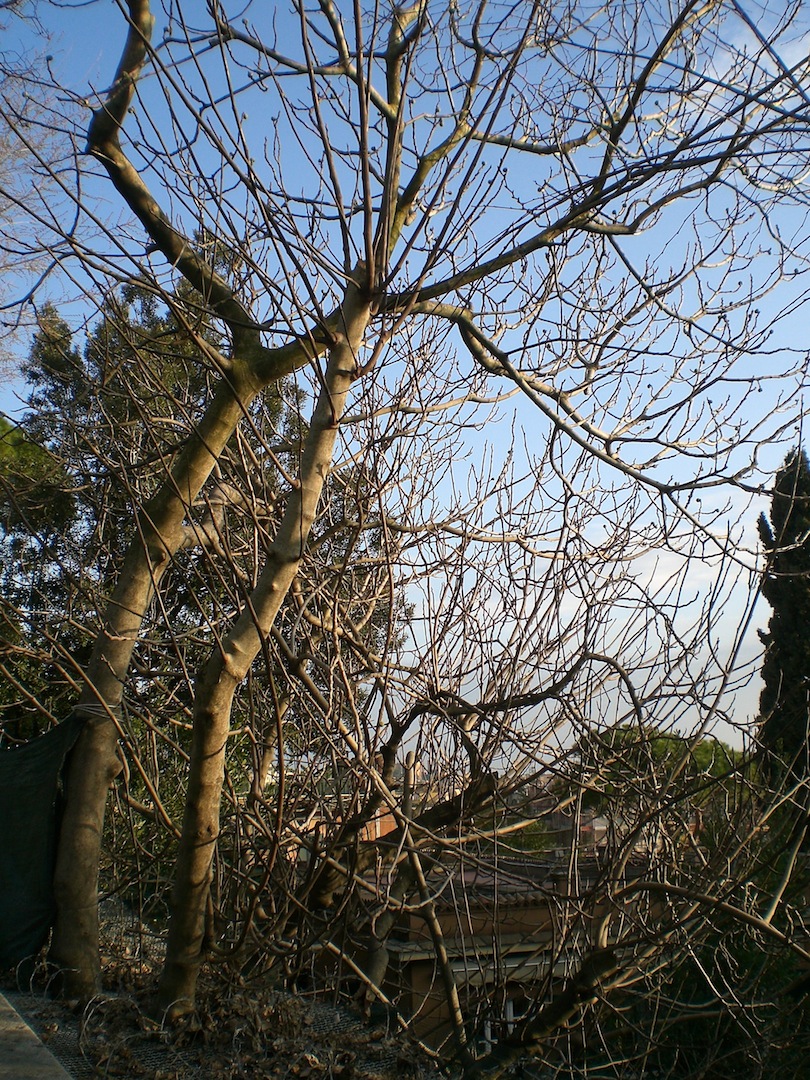
Recently I was lucky enough to take an 8-day trip to Italy.  I visited Rome, Florence, Tuscany, and many other small towns in between. Saw all the major sights, enjoyed unbelievable food, and had a great time.  What surprised me most (aside from the entire experience) was the abundance of fig trees, citrus, olives, grapes, and other beautiful plants scattered all over the country, not just in the vineyards of Tuscany.  Figs were literally growing out of stone and marble walls in Rome.  The following umpteen hundred pictures show the landscape and these plants:

Massive fig tree near the Spanish Steps in Rome.  This tree is about 25-feet tall and begins growing down the hill from where I took this photo.
Well manicured garden in Vatican City with very large potted citrus. Unfortunately you can't access this garden. I snapped this picture from inside the Vatican.
Multi-trunk fig tree growing directly across the street from the Colosseum.  There were a few of these within a couple hundred yards of each other.  
Fig tree (just right of center) in the Roman Forum.
Fig tree in the Roman Forum from a different angle.
Same fig tree in the Forum from a 3rd angle.
Smaller branching fig tree growing from the rocks near the Spanish Steps in Rome.
Orange trees lining the street in central Rome.  I took this pic from my hotel room on the 4th floor.  They grew large and healthy all over the city.  And of course everything within arm's reach was already plucked and devoured.
Vineyard at the 16th century Castello d'Albola in Tuscany.  They produce acclaimed Chianti and Cab Sauv, as well as sublime olive oil.
More neatly pruned and trellised grapes at Castello d'Albola in Tuscany.
Olive trees near Radda in Chianti.  Famers were in the process of pruning the olive trees and burning the cuttings.  You could see and smell small plumes of smoke all over the countryside.
More olive trees.
Even more olive trees.
Approximately 20-foot tall fig trees at Radda in Chianti, Tuscany.
A close-up of the same fig tree in Radda.  I don't know what type of fig it is, but it was easily the most dense and multi-branched fig tree I've ever seen.  Hard to imagine enough light would reach the interior of the tree to ripen figs in the summer.
The fig tree is located right by the road.  You could easily harvest ripe figs from your car in the summer.
I spotted this beautiful blooming tree at a local ceramic maker's shop in Tuscany.  I couldn't figure out what it was until I saw the remnants of the previous year's bounty on the ground beneath the tree.  Almonds!
Almond blossoms. Bees were buzzing about the tree pollinating the flowers.
More almond blossoms clustered together with the ceramic shop in the background.
Grape vines across the street and up the hill from the ceramic shop.  Trellised vines as far as the eye could see, all over the countryside.
I don't know hold old these vines are.  They were not the youngest or oldest vines I saw, but were probably somewhere in the middle.
They prune the vines to maintain growth and productivity.
Close-up of recently pruned grape vine.
The skyline of the small medieval town of San Gimignano in the provence of Siena, Tuscany.  It was a cold and cloudy day.  Note the very large fig tree in the lower left-hand corner of the picture.  
Close-up of the large fig tree in San Gimignano.  Note the old wooden ladder leaning against the trunk of the tree.  I wish I was there in the summer to climb the ladder and sample the fresh figs.
I hope you made it to the end of this post without being bored out of your mind.  Yes, the art, architecture, and culture of Italy are out of this world.  But at the same time, the variety and abundance of plants nestled within this historic setting are no less impressive and equally as beautiful.