Showing posts with label Propagation. Show all posts

Thursday, February 23, 2012

Good Cause + Donation = Fig Cuttings

My friend and fellow garden blogger Sybil is celebrating a milestone birthday by biking 200 miles for a charity fundraiser.

http://usefulgardens.blogspot.com/2012/02/figs-figs-figs-cuttings-for-you-help.html

If you are interested in supporting her cause with a donation, she will send you your choice of a dozen fig cuttings from some of the most amazing varieties of fig trees. And Sybil knows her figs -- she and her husband owned Paradise Nursery, a well-respected and sorely missed nursery of fig trees and other edibles in Virginia Beach that closed a few years ago.

Violette de Bordeaux figs ripening in late summer.

Don't miss this opportunity. Support a good lady and good cause, help some teens, and get some incredible fig cuttings from one of the most respected fig growers on the East Coast!

If you are interested in donating but unsure how to turn fig cuttings into fig trees, check out these two links:

http://point09acres.blogspot.com/2011/07/propagating-figs.html
http://figs4fun.com/basics_Rooting.html

Thursday, November 3, 2011

Enjoying the Fall Garden

Like many people, I started out as a spring and summer vegetable and fruit gardener. Warm weather meant planting and harvesting. Cold weather meant waiting for next year's harvest.

It took me a few years and lots of trial and error to realize that cool season gardening can sometimes be the most rewarding gardening of all. The most notable differences between fall and summer gardening in Zone 7b are comfortable temps, very few bugs and pests, care-free veggies, and generally easy tasks. 

In its simplest form, fall gardening consists of sowing seed (in late summer), watering, mulching, more watering, and harvesting. That's just about all there is to it. Some hardier crops even survive repeated frosts and in a location like Newport News, VA, a productive four season garden is a realistic goal. 

I took the following photos of my fall garden at .09 Acres on Halloween, 2011.  

Long rows of Buttercrunch and Winter Density lettuce.
Young Rouge d'Hiver lettuce sown in succession with other lettuce varieties to extend the harvest. Succession planting spreads out the harvest over a few weeks or months.
Long Standing Bloomsdale spinach. This is my first attempt at growing spinach. I found that warmer soil temps in late September definitely hindered germination, but the spinach seems much happier in early November.
I had spotty germination of my carrots. Notice that the center two rows filled out nicely while the outer rows (far left and far right) are fairly sparse. I'll have to wait and see how they do this year. Last year was an amazing year for carrots.
It's tough to beat good beets. Here are four short rows of Detroit Dark Red and Chioggia beets. These are still quite young and probably need another month to grow. I thinned them in mid-October to allow the beet roots to grow larger, and I added the thinned greens to a salad. Definitely a great addition.
I am growing kale from seeds I saved (this spring) from last years kale plants. I battled tiny caterpillars for a few weeks when the plants were young, and you can see some of the leaf damage they caused in this picture. 
I am growing broccoli in two large pots and in a raised bed. I'm curious to see whether it grows better in-ground or in the pots. I can't remember if I planted Calabrese or Waltham broccoli. I have to check my seek packet. I may have started these seeds too late for the plants to mature in time to produce harvestable broccoli, but only time will tell. The tiny caterpillars that hit my kale also like the broccoli. Damage is visible on the right-most leaf.
Apple mint growing in half a wine barrel near the gate to my yard. It has made an amazing comeback from the crippling heat of mid-summer. This plant thrives in mid-late spring, suffers through summer, then regrows with a vengeance in fall. This entire barrel grew from a small rooted cutting I dug up from a yard where I previously lived. Mint will take over the world if it's not contained, but it's also a must-have in any yard.
Russian Red pomegranate ready for harvest. There are appx. twenty of these hanging from my 4-year old pomegranate tree. I can't say enough good things about this tree.
Negronne figs that definitely will not have enough time to ripen before the first frost. This tree keeps growing larger and producing more figs. Next year should be an amazing harvest. 
Two unripe Eureka lemons hanging from a small branch on my potted tree.
New foliage on my Eureka lemon. It usually starts out with a reddish tinge, then turns bright green as the leaves grow and mature.
More blossoms keep appearing on my potted Bearss lime tree. Citrus flowers are arguably some of the best smelling flowers in nature. My lime tree is currently holding about 10 limes. After last year's harvest, I thought it could've grown 50 limes this year. But a strong gust of wind knocked it off a table in early spring and snapped off the main trunk. I'm pretty sure I cried when I finally found out what happened.
Baby Bearss limes growing from recently pollinated flowers. I won't be dining on these limes for a LONG time!
What are your favorite fruits and veggies to grow in the fall? Are you thinking about adding additional cold-weather protection like floating row covers or plastic-covered hoop houses to extend your harvest into the winter? Fall is finally here so welcome it into your garden.


Tuesday, September 27, 2011

Rain, Rain, Go Away...

We've had rain here in Newport News for the past week. I'm talking lots of rain. Morning, noon, night.

The rain has been a bad thing and a good thing. I'll start with the bad. My last few precious tomatoes from a generally measly summer crop were ripening on the vine last week. I was hoping for one last harvest. Then the rain moved in. It split the skins of my Black from Tulas and they quickly went downhill from there. See for yourself.

Black from Tula tomatoes after a week of relentless rain.
The rain brought somewhat cooler temps for a day or two, but then the temps climbed back into the 80s as the rain continued to fall. The warm, wet conditions weren't great for the tomatoes, but it was ideal for MUSHROOMS. I woke up last Friday morning and there were mushrooms as far as the eye could see!  I'm talking hundreds, if not thousands, of mushrooms in my backyard.

Cluster of small tan mushrooms in the garden.
There seemed to be two different varieties of mushrooms, and it was interesting to note that they grew wherever I had spread wood mulch earlier in the spring. I guess the wood chips contained the spores even before I spread them in the yard, or the spores found the moist wood mulch an ideal environment for growing. Either way, .09 Acres turned into a mushroom farm overnight. I don't know much about mushrooms, but I wasn't taking any culinary chances. I took my cues from my dogs and the neighborhood wildlife. Since they wouldn't eat them, I wouldn't either. There were so many mushrooms that even the resident Smurf population had a hard time navigating their way around .09 Acres.

Papa Smurf navigating his way around a morass of rogue mushrooms.
Rotten tomatoes and a plethora of mushrooms were two ill-effects of constant rain. But the upside of all that moisture was ideal seed-starting conditions. Before the rain, I planted a variety of seeds including broccoli, kale, beets, carrots, onions, Swiss chard, spinach, and lettuce.  Almost all of the seeds germinated, and I'll provide a detailed update about my fall garden in an upcoming blog post.  

Stay dry and keep your fingers crossed for cooler weather.

Friday, July 8, 2011

Propagating Figs

Back on March 28, I started to root approximately 100 fig cuttings in plastic 16 ounce cups filled with moist perlite. I used dormant cuttings ranging in size from 8"-12". I was moderately successful rooting Celeste figs in previous years, so this year I was excited to get access to a wide variety of figs including Blue Celeste, Panache, Alma, Hardy Chicago, Strawberry Verte, Violette de Bordeaux, Osbourne Prolific, and Italian Golden Honey. It's been just over 3 months since I started the cuttings, and to date I have successfully rooted many cuttings. I am now in the process of transitioning the rooted cuttings from perlite to compost in plastic nursery pots to grow in the shade until they are established. The following pictures show the process:

Assorted fig cuttings in perlite.  This picture was taken on March 28.  I kept them inside my unheated garden shed until the weather warmed, then I moved them outside onto a table beneath a shady tree where they stayed for a few months.  The rooting process really speeds up in warm/hot humid weather.  This makes the process easy and successful in southeastern Virginia.
Here is a rooted cutting of Hardy Chicago on July 7.  Notice it has lush foliage.  Here's where it gets tricky.  Foliage growth is not necessarily a sign that the fig has rooted.  Sometimes a cutting will grow leaves but not roots.  This is why potting in clear plastic cups is an advantage.  It's much easier to see if and when roots have grown.
Check out the root growth in the bottom of the plastic cup.  I decided to transition this cutting from perlite to  compost in a plastic pot because of the strong root growth AND new foliage.
Here's a photo of the rooted cutting after I removed it from the cup.  The roots are holding the perlite together.  
I put a few inches of compost in the bottom of a pot and place the rooted cutting into the pot.  The perlite usually crumbles apart but it's not a big deal.  I like to include all the perlite from the cup because I believe it helps to transition the cutting to the new potting media. I use the inside of an old wheel barrow as my potting area. 
I make sure the cutting is vertical and then I add compost to the pot until it is even with the rim. I never compress the compost around the new cutting because I believe it can damage the young roots. Compost is light and fluffy and the rooted cuttings seem to respond well to it.
Here is a final picture of the new Hardy Chicago fig.  It's been watered and labeled.  A good labeling system is very important because it's easy to get them all mixed up when you have dozens of cuttings and no labels.  I also do not add any fertilizer.  The compost provides sufficient nutrients for the remainder of the year. This cutting will now join the others in the shady canopy of a massive crepe myrtle.  Once the fig shows strong new growth, I'll move it into a sunnier location.  As long as I keep my cuttings watered, they'll grow 4-5 feet by the time October rolls around and temperatures cool down.
Propagating new fig trees from cuttings is a fairly easy process. The hardest part is waiting!  I encourage you to give it a try. Before you know it, you'll have a yard filled with fig trees.

Monday, February 14, 2011

Starting Seeds

It's almost seed starting time.  With that in mind, I spent some time over the past few days readying my seed starting operation in my shed.  It's a fairly simple operation with only 4 ingredients: seeds, seed starting mix, heat, and light.  Fortunately I have saved many seeds from the past few growing seasons so I've got that covered.  I also have leftover sterilized seed starting mix.  It retains moisture but also drains well.  And last spring I decided to get serious and devote a few bucks to the heat and light portion of this equation.  What did I buy?  Heat mats and simple fluorescent light fixtures.  Nothing too fancy.  One heat mat was also a gift, thanks Frank and Robin.

From top to bottom: two 4-foot fluorescent light fixtures, seed trays, and heat mat.  
The first photo is my exact setup from last year.  This year I wanted to expand the operation to grow even more plants so I doubled it.  I now have two heat mats that hold four seed trays (8 total), four light fixtures (each holds two bulbs), and timers for the lights.

I had trouble fitting the whole setup in a single picture so I opted for this view.  Not a great shot but it gives you an idea of what it looks like.
Automated timer.
The automated timer makes everything easy.  I can program it to come on early and turn off late in order to provide maximum light for my UV-hungry seedlings.  I don't have to get up early or stay up late to fiddle with lights.  You can call me lazy, but I call it efficiency.  I also like to keep the lights very close (within a few inches) of the seedlings. Strong light leads to thicker, sturdier, stronger plants.  Low light leads to weak, spindly plants.  The lights are on chains so I can raise them incrementally as the plants grow taller.

You can also buy thermostats to control your heat mats. Unfortunately I don't have thermostats so I keep a thermometer and humidity gauge nearby for reference.  It's not the most accurate gizmo but it's a good reference.

Pick one of these up at your local hardware store.
I'm still trying to sort out what I will start in the seed trays.  Definitely the longer growing season staples like tomatoes, peppers, etc.  I usually transplant those to slightly larger containers and place them back on the heat mats for further growth before planting them outside. I also plan on starting lettuce and other veggies.  I don't recommend growing root veggies like carrots, beets, or radishes in trays.  They do better when directly sown in the garden.  And fast growing plants like cucumbers aren't usually worth growing in cells.  I also sow those directly outdoors.

What do you do to prepare plants for the upcoming season?  Peat pots, cups of seeds on a bright windowsill, pots outdoors?  Wait for warmth and plant in the garden?  I'd love to hear from you.  I'll post again after I start the process and germination is underway.

Monday, August 2, 2010

Figs!

I'm a fig junkie.  Right now many of you are probably rolling your eyes thinking about grandpa's nasty dried figs.  But if you haven't eaten a fig plucked FRESH from a tree, you don't know what you're missing. I eat them whole, sliced, chilled, and even grilled.  And yes, also dried when not in season, but it's like comparing apples and oranges.  There are many tasty varieties that do well in southeast Virginia.  Right now I'm growing Violet de Bordeaux, Black Jack, Celeste, and Peter's Honey.  I've been growing them for a few years and they are still relatively small.  Violet is definitely my favorite, Black Jack is so-so, Celeste is old reliable, and Peter's Honey is a green fig that hasn't done very well this year.

Unripe Violet de Bordeaux figs.  They are very dark and droop when ripe.
Ripe Violet de Bordeaux figs.  Notice the distinct change in color and size when ripe.
It's actually quite easy to propagate figs by rooting dormant cuttings.  I took cuttings of my uncle's Celeste fig tree late last winter and rooted them in perlite this spring.  Then I moved them to 1 gallon pots and now they are growing like weeds.

2-3 feet tall rooted cuttings from a mature Celeste fig tree.
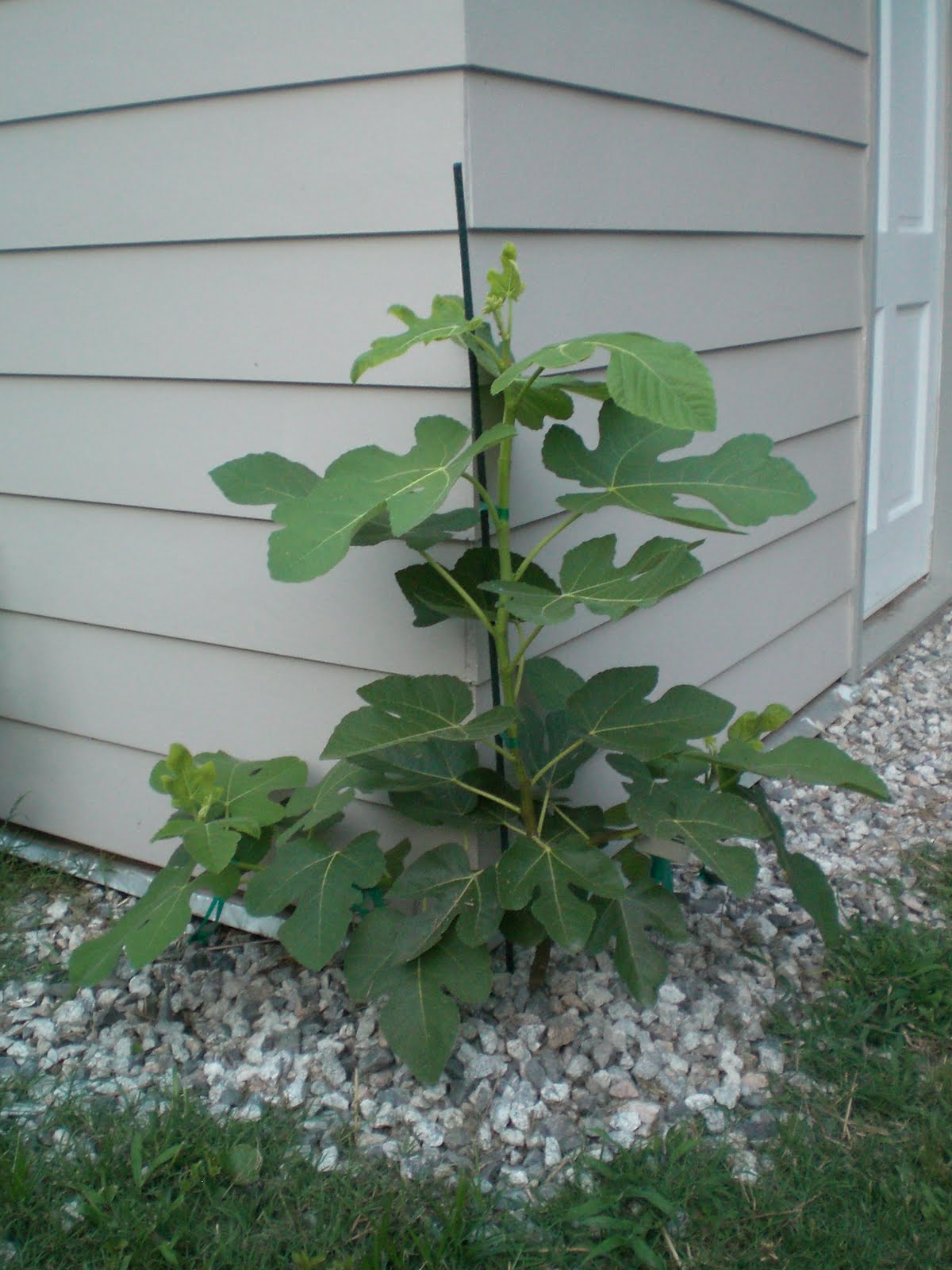
I'm also growing an espalier fig against the corner of my shed.  I'm training two long branches very close to the ground (much like a stepover) and growing two more branches a few feet up, similar to a traditional multi-tier espalier.  It will take a few years to train the fig for the right appearance, but I'm looking forward to the challenge.  Notice the growth from the left picture (early June) to the right picture (early August).  The tree currently stands about 5 feet tall and is developing nicely.