Showing posts with label Grass. Show all posts

Thursday, January 19, 2012

Back in the Garden Again

My apologies!  It's been well over a month since my last post. The holidays and an INTENSE workload really put a dent in my gardening and blogging time. In the past 6 weeks I've done little in the yard and nothing with the blog.

Considering my neglect of the garden during this period of time, I expected Mother Nature to force me to tighten my belt a notch or two by wreaking total havoc on my tasty veggies and herbs. I imagined hard frosts, harsh winds, and cold dry air conspiring against me. I pictured languishing lettuce, crusty carrots, and beat up beets.

What did I find? Beautiful broccoli.

Calabrese broccoli head approximately 8" in diameter. This plant was grown in a glazed ceramic pot.
Don't think broccoli is beautiful? How about now?

Calabrese broccoli head.
This head of broccoli looks almost like a coral reef you'd expect to see off the Florida Keys rather than in a backyard garden in Newport News, Virginia. This plant was grown from seed in a large glazed ceramic pot. I mulched it with a thick layer of wheat straw after it germinated and haven't fussed over it since then. Yes, I hand-picked a few caterpillars but did little else. It is also growing smaller side shoots that I will only cut after I harvest the main head.

What else did I find that I didn't deserve? A cool cover crop.

Diego standing guard over a 4' x 8' bed of winter rye and hairy vetch cover crop.
I purchased Wren's Abruzzi Winter Rye and Hairy Vetch cover crop seeds last September from Southern Exposure Seed Exchange at the Heritage Harvest Festival at Monticello. I mixed and planted them in a 4' x 8' bed previously occupied by my Inchelium Red garlic. The seeds germinated easily and very quickly filled the bed. It's a vibrant addition to the otherwise muted colors of the winter landscape. I plan to cut and till the cover crop into the bed in early spring before planting tomatoes in late spring.

The cover crop is also important for another reason I did not anticipate. Dogs are natural foragers, and my two dogs often ate grass in my previous yard to aid in digestion. By successfully smothering my grass, I unintentionally eliminated one of their favorite diet supplements. Last summer, I often found my dogs sampling different weeds and other greens because they were looking for a suitable substitute for their favorite but now missing forage. As soon as the cover crop germinated and grew, Diego would regularly run over to the bed and dine on selected shoots of Winter Rye. He still does, seems to love the stuff! So in a way, it's a happy system. Soil feeds cover crop; cover crop feeds soil, dog, and future plants; plants feed human; human feeds cover crop to the soil; repeat. My only concern is that Diego doesn't get comfortable dining on whatever he choses from the raised beds. That could be a problem.

Maybe I'll construct a bone-shaped raised bed for dog edibles...then again, maybe not.

The broccoli and cover crops are just two of the many reasons why Diego and I are beginning to appreciate winter gardening more than summer gardening. There is little to do after planting and germination other than to harvest the rewards of Mother Nature. No toiling, no tilling, no sweating.

Many other veggies are doing very well despite my neglect, but I'll save them for another post. Hope all is well in your gardens.

Thursday, June 9, 2011

Early June

I'm back.  It's been almost 2 months since my last post.  Too long. Figured I'd do a big pictures post from the yard.  It's been an interesting and productive Spring, with a few setbacks as well. Generally speaking the garden is doing great.  Let's start with the good then I'll move on to the bad and ugly.  I successfully saved seed from my Vates kale and two varieties of Swiss chard.  They get tall when they bloom.  I'm talking 6-feet tall!  I added about 4" of fresh compost to each bed and built a small extension designated for herbs. Cucumber production has been nothing short of amazing.  I've got 5 Burpless plants in the ground and I'm pulling about 8 cukes/day.  I planted borage as a companion plant to my tomatoes, and it  is growing very well.  Beautiful flowers and they are edible too.  Peaches are hanging from the tree, the pomegranate is still in bloom. Raspberries were a tasty treat for about 3 weeks and are slowing now, but the blackberries are starting to kick in.  Figs have also put on new growth and, more importantly, many figs.  Not as many as I hoped for, but I pruned them back in early spring to encourage more branching for larger future harvests.  The fig espalier is developing fairly well.  I also just finished harvesting approximately 50 heads of Inchelium Red garlic and they are drying in my shed.  That's a short version of the good.

Now for the bad.  My precious, beloved, sacred, and coveted heirloom tomatoes are taking a beating.  They grew well for the first 6 weeks after I transplanted them into the garden, and they grew large.  I'm talking appx. 4-5 feet tall.  Then I started noticing what I believe to be blight.   It first appeared on a few leaves, then a stem, a truss of tomatoes, an entire stalks.  I quickly pruned those areas, sterilized my pruners, and then moved to the next plant.  But it kept moving.  So this past weekend and evening I ripped out 5 of my 7 in-ground tomatoes.  2 German Johnson, 1 Black from Tula, 1 Bull's Heart, and 1 Marvel Striped. I don't know why it hit so hard.  I immediately tossed them in the garbage bin.  I've been careful about watering, 2 doses of organic foliar feed (spaced 4 weeks apart) in the early morning, etc. etc., but I guess a large harvest like last year wasn't meant to be.  I'm planning on purchasing a few more plants and probably dropping in a few seeds as well, but I'm flat out bummed.

And the ugly.  Despite my best attempt at smothering the grass, it's back.  And lots of it.  Multiple layers of cardboard, 4-5 inches of mulch, periodic hand weeding of the errant shoot of grass, all for nothing.

Alright, enough gibberish!  Let's do the photos, shall we?
This is a mix of the good and the ugly.  Figs down the left, raised beds front and center, berries/peach/pomegranate on the right.  Oh yeah, and grass everywhere...son of a...
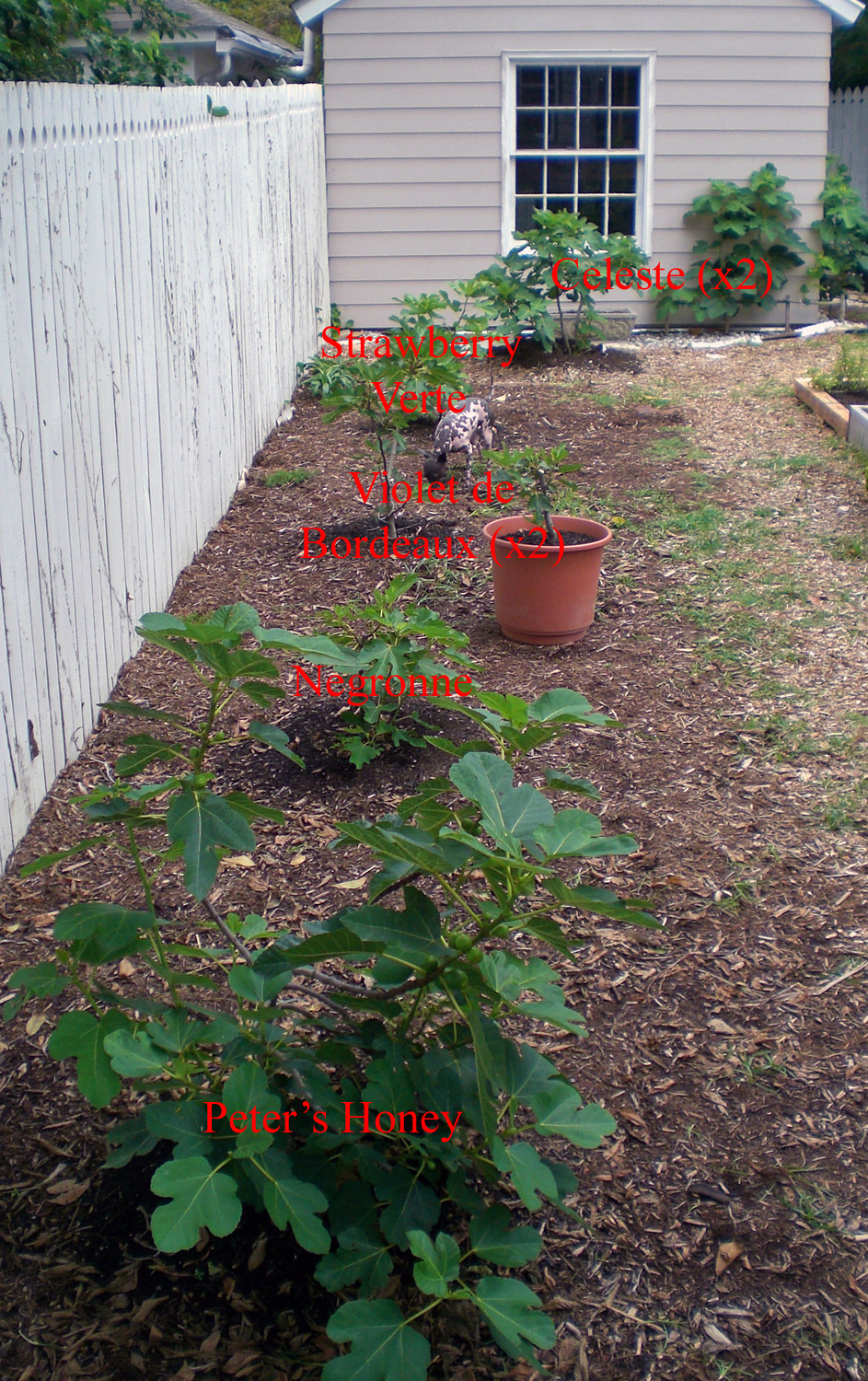
Row of figs down the left wall of the yard.  They are all fairly small, but are adapting well to their permanent location.  I grow a mix of brown, purple, and green figs.   If you look closely, you can spot Scout.  She's the hairless wonder dog.
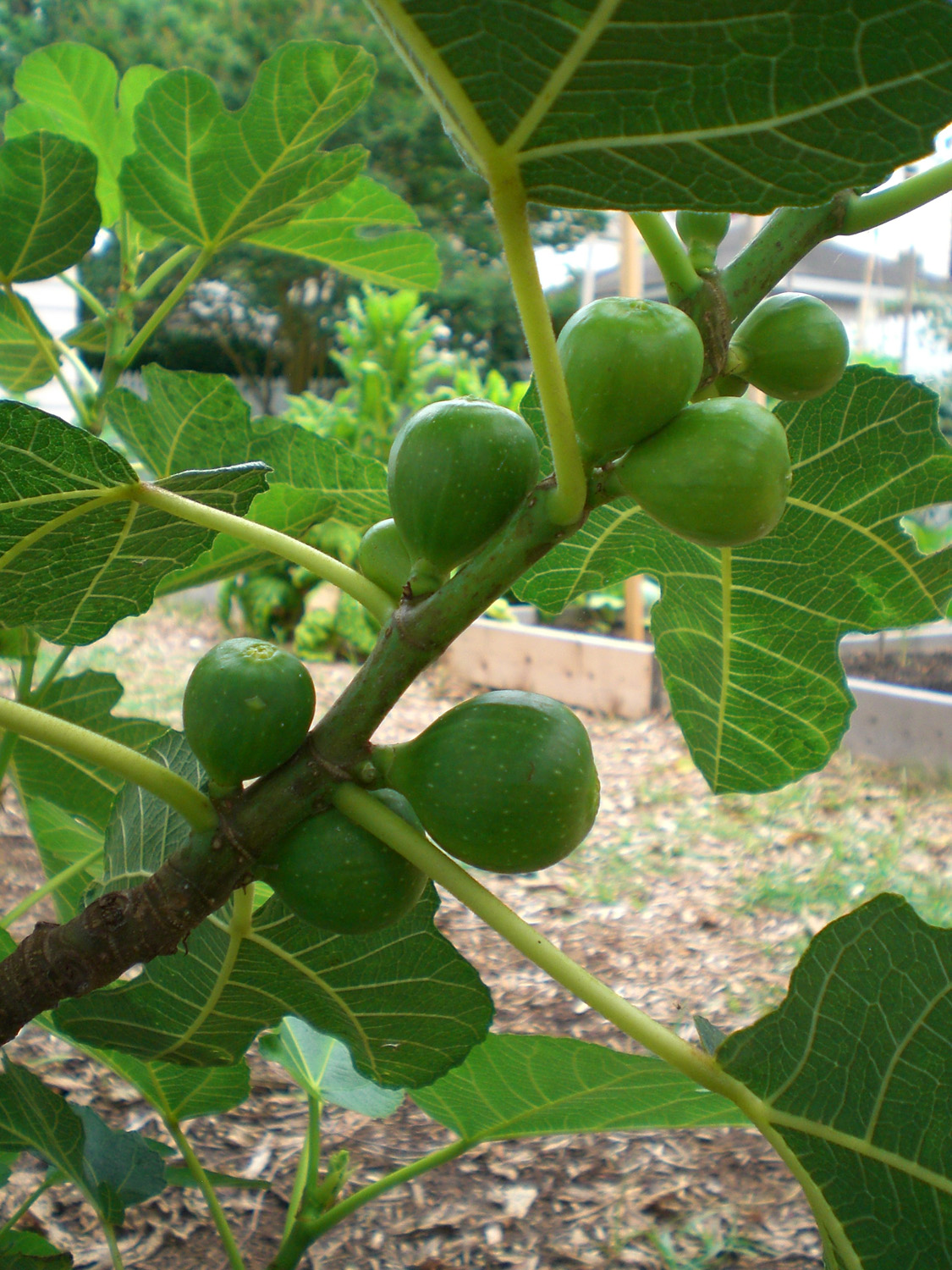
Peter's Honey fig.  In some areas this plant is putting out 2 figs per leaf, and I don't think that's very common. I'm not complaining.
Violet de Bordeaux figs.  I will pick individual ants off the tree to protect these, partly because I'm crazy but mostly because these things are heavenly.
The Red Haven peach tree is getting very large.  I pruned it heavily this winter and again about 3 weeks ago, and it keeps on growing.  I also thinned the fruits a while ago, but it's still hanging about 25 peaches.
Overhead view of the Red Haven peach tree showing the main scaffold limbs.  I'm trying to maintain an open center to allow light in and air to circulate.
I haven't sprayed this tree with a single thing this year and it still looks healthy.  I hope that holds up for the rest of the year.
The Russian Pomegranate also likes its sunny but sheltered location.  It's approximately 7' x 7' and was covered in blooms for 3 weeks.
A tiny pomegranate and a few blooms in the background.
This is a young Haku-Botan pomegranate tree, courtesy of Sybil Mays.  It will eventually produce yellow/gold pomegranates.  Sybil, this is the little plant you dug up from your side yard.  It has recovered and grown ALOT!
It's a cucumber jungle out there.  By now they've established very deep roots and don't show much wilting during the hottest (98 degrees) driest weather this year.
These beasts make a mean cucumber salad.
Ouachita blackberries beginning to ripen.  I'm not sure exactly what happened (or didn't happen), but I think poor or incomplete pollination led to irregularly shaped berries.  Look closely in the picture and you'll see what I'm talking about.
Almost ready.
All the literature says that borage flowers have a cucumber taste.  I disagree.  They taste like borage flowers.  Not really cucumbery, but just a general leafy green pleasant flavor.  I grew these as a companion plant for the tomatoes, but it clearly hasn't helped this season.  
Don't ask me how this partially ripened black cherry tomato tasted.  I wouldn't know.  My dog Diego ate it so you'll have to ask him.  
When most people draw a picture of the devil, they draw a red devil.  The devil is NOT red.  The devil is green.  Check out this mix of Bermuda grass and some other green beasts that are growing well despite Operation Smother.
Bermuda grass a-creepin'.  This is the aforementioned ugly.  I plan on pulling everything I can by hand rather than using some ineffective organic herbicide or crazy poisonous herbicide.  I do not want to mow this back yard ever again.  
I'll post again soon with pictures of the garlic harvest as well as the fig espalier.  How are things growing in your gardens?  If you are fortunate enough to have a bumper crop of heirloom tomatoes later in the summer, I'll likely be begging at your front door. That's a promise.

Thursday, April 14, 2011

Happy First Birthday .09 Acres!

It's officially been one year since I built the first raised beds and planted a few berries in the ground at .09 Acres.  The time has flown by so fast.  But before I even dug a spade into the ground or removed a single overgrown vine, I was running through all the possibilities in my mind.

Let me go back a little earlier than a year ago.  I want to start with a few photos I took in September 2009, a month before we purchased the house.  The yard was nice....quiet, private, and ordinary.  It was the type of yard you'd expect to find in my neighborhood.

September 2009 at .09 Acres.
The main problem I saw was that the yard was the exact opposite of what I wanted in a yard.  Grass that needed to be mowed, fertilized, and edged.  Overgrown bushes, shrubs, and invasive vines and ground cover that needed to be tamed and maintained.  I didn't want any of that.  I wanted to create an edible landscape filled with veggies, fruits, and herbs.  No grass, raised vegetable beds, a variety of different fruit trees.  This couldn't be the place for me.  Or could it?

Despite the numerous drawbacks, the property offered many things I was looking for in a yard.  Full sun exposure for 8-10 hours per day.  A manageable size.  Privacy fencing that offered seclusion and also created a slightly warmer micro-climate.  And a fairly open layout that I could configure any way I wanted.  Maybe this was the right place!

We eventually purchased the house but I didn't dive into the yard until we had spent a few months working on some DIY renovations inside. I finally got out into the yard in early spring and pruned or removed many overgrown shrubs, bushes, and trees.  I ripped out the creeping groundcover, and even moved the fence closer to the property line to reclaim some additional footage (it all counts in a small yard!)  By that point it was April, 2010 and I was ready build some raised beds and plant some edibles.

April 2010 at .09 Acres.
You can see a large difference between September 2009 and April 2010.  I gained quite a bit of square footage by removing old plants and moving the fence.  I also pruned the grand old Japanese Maple (back left in the above photo).  Unfortunately I had to remove it later on after I discovered that its roots caused some major damage to some nearby plumbing.

I worked when I could.  An evening here, weekends there, official holidays, work holidays. I even dragged myself outside when I was sick to pull a weed or water a new plant.  It borders on obsession at this point.

Here we are one year after I built the first raised beds.  What does the place look like now?  To be quite honest, it looks a bit bare.  But I intentionally provided sufficient space between the fruit trees to allow them ample room to grow and thrive in the coming years.  And hopefully they will.  Now the peach tree and berries are growing like crazy, the young fig trees are starting to leaf out, and I'm preparing to plant new veggies in the raised beds.  Within a few weeks the whole yard will be alive.

April 2011 at .09 Acres.
I added labels to the picture to show what is planted in the yard.  I selected the left-most fence (facing south) for my fig trees.  I have 5 different varieties in the ground.  The berry trellis is near the right-most fence (facing north).  It still gets great sun during the day.  I tucked a peach tree and pomegranate tree closer to the house for protection against cold winter winds and to ensure that they would stay dormant just a little longer than usual to prevent against damage from a late frost.

The original 5 raised beds have been joined together.  I added the rough overall dimensions of these long beds to give an idea of how much produce I can grow.  I opted for raised beds because the ground is very low and drains slowly after a good rain.  I also smothered the grass and weeds with layers of cardboard and mulch.  I'm not sure how effective that will be over the long haul.  Only time will tell.

I didn't really know what creating an edible landscape would take in terms of time, labor, and expense, but I went for it.  By no means am I done, but I've accomplished quite a bit.  I know the yard will continue to change and evolve.  I'll have more successes and setbacks, more elation and deflation (is that a word?), and that's what makes it exciting.  Equally exciting is the pride and enjoyment of harvesting a basket of ripe heirloom tomatoes, watching figs ripen in the sun, and plucking sweet raspberries and blackberries off the trellis.  Sure beats mowing the lawn, doesn't it?!

Monday, February 7, 2011

Laying Down the Law(n)

I know I've said it before, but I'm done with mowing.  No more.  Finis.  With that in mind, I have been making a concerted effort over the past few weeks to kill the grass and weeds in my backyard.  I don't want to use chemicals, out of the question.  I don't want to dig and till and pull, too much effort.  Smothering is the name of the game, or at least it's what I'm attempting to do with wheat straw, cardboard, and mulch.

Layers of wheat straw, cardboard, more straw, and a few inches of mulch on top of grass and weeds.
It rained all day Saturday.  Rained hard.  Most sane people were inside staying warm and dry.  I'm not sane.  I moved 4 cubic yards of mulch from the city compost facility in 1 yard loads, then shoveled it into a wheelbarrow and carted it into my backyard.  I couldn't think of a better way to spend 7 hours on a Saturday.  Like I said, I'm not sane.  Sanity doesn't run in the family.  I remember watching my 75-year-old grandfather climb a tree with one arm while holding a chainsaw with his other arm.  I also remember my dad mowing the lawn at night after a long day at work.  I figured moving mulch in the rain wasn't out of the ordinary.

For a few weeks my strategy involved spreading wheat straw all over the portions of grass I wanted to smother.  I followed that up with layers of thick cardboard.  I made sure to  provide significant overlap from piece to piece to avoid gaps in the coverage.  Then I added another layer of straw and finally a thick 3-4" layer of fresh mulch.

My dog, the ever loyal sentinel, inquisitively patrolling his new turf.
I did not have enough cardboard or mulch to complete the whole process, but I finished approximately 70% of the yard.  I deliberately avoided putting down mulch in the areas between raised beds.  I intend to join those sections of beds to create a longer growing area.  Yes, I'll lose the convenience of being able to walk between the individual beds, but I'll gain the extra planting space and I'll just have to take a few more steps to reach the other side of the beds.  Essentially, I'll have 2 very long beds instead of smaller ones.  It's a small yard so every inch of growing space is at a premium.

Un-mulched area between two raised beds.  The top left bed contains kale and the lower right bed contains carrots.
I plan on using the same type of untreated 2x8's to enclose the un-mulched sections for planting.  I'll likely plant the new spaces with tomatoes since I planted the majority of beds with tomatoes last summer.  This will provide me with some additional rotation space and will prevent the buildup of pests and diseases in last year's locations.  

Overall shot of newly mulched area of yard.  Pomegranate tree branches in right foreground.
I'm gambling on the idea that layer upon layer of mulch will smother the grass and weeds. The concept is also quite similar to lasagna gardening.  I have no doubt that grass and other things will conspire against me and grow, but I'm hoping for the best.  In the photo above, I still need to mulch the area between the covered beds and white fence, the area in the back right adjacent to the shed, and the area behind and to the left of where I was standing when I took this photo.  I will post more about my plans for the area near the white fence at a later date this winter or early spring.  Think fig trees...